Readings Newsletter
Become a Readings Member to make your shopping experience even easier.
Sign in or sign up for free!
You’re not far away from qualifying for FREE standard shipping within Australia
You’ve qualified for FREE standard shipping within Australia
The cart is loading…


This title is printed to order. This book may have been self-published. If so, we cannot guarantee the quality of the content. In the main most books will have gone through the editing process however some may not. We therefore suggest that you be aware of this before ordering this book. If in doubt check either the author or publisher’s details as we are unable to accept any returns unless they are faulty. Please contact us if you have any questions.
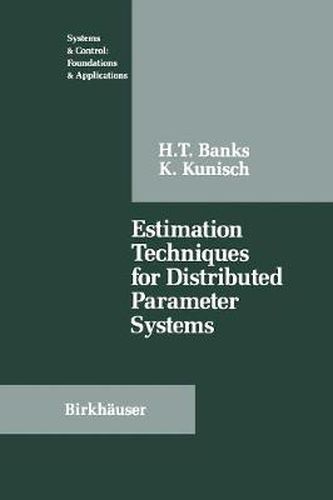
The research detailed in this monograph was originally motivated by our interest in control problems involving partial and delay differential equations. Our attempts to apply control theory techniques to such prob lems in several areas of science convinced us that in the need for better and more detailed models of distributed/ continuum processes in biology and mechanics lay a rich, interesting, and challenging class of fundamen tal questions. These questions, which involve science and mathematics, are typical of those arising in inverse or parameter estimation problems. Our efforts on inverse problems for distributed parameter systems, which are infinite dimensional in the most common realizations, began about seven years ago at a time when rapid advances in computing capabilities and availability held promise for significant progress in the development of a practically useful as well as theoretically sound methodology for such problems. Much of the research reported in our presentation was not begun when we outlined the plans for this monograph some years ago. By publishing this monograph now, when only a part of the originally intended topics are covered (see Chapter VII in this respect), we hope to stimulate the research and interest of others in an area of scientific en deavor which has exceeded even our optimistic expectations with respect to excitement, opportunity, and stimulation. The computer revolution alluded to above and the development of new codes allow one to solve rather routinely certain estimation problems that would have been out of the question ten years ago.
$9.00 standard shipping within Australia
FREE standard shipping within Australia for orders over $100.00
Express & International shipping calculated at checkout
Stock availability can be subject to change without notice. We recommend calling the shop or contacting our online team to check availability of low stock items. Please see our Shopping Online page for more details.
This title is printed to order. This book may have been self-published. If so, we cannot guarantee the quality of the content. In the main most books will have gone through the editing process however some may not. We therefore suggest that you be aware of this before ordering this book. If in doubt check either the author or publisher’s details as we are unable to accept any returns unless they are faulty. Please contact us if you have any questions.
The research detailed in this monograph was originally motivated by our interest in control problems involving partial and delay differential equations. Our attempts to apply control theory techniques to such prob lems in several areas of science convinced us that in the need for better and more detailed models of distributed/ continuum processes in biology and mechanics lay a rich, interesting, and challenging class of fundamen tal questions. These questions, which involve science and mathematics, are typical of those arising in inverse or parameter estimation problems. Our efforts on inverse problems for distributed parameter systems, which are infinite dimensional in the most common realizations, began about seven years ago at a time when rapid advances in computing capabilities and availability held promise for significant progress in the development of a practically useful as well as theoretically sound methodology for such problems. Much of the research reported in our presentation was not begun when we outlined the plans for this monograph some years ago. By publishing this monograph now, when only a part of the originally intended topics are covered (see Chapter VII in this respect), we hope to stimulate the research and interest of others in an area of scientific en deavor which has exceeded even our optimistic expectations with respect to excitement, opportunity, and stimulation. The computer revolution alluded to above and the development of new codes allow one to solve rather routinely certain estimation problems that would have been out of the question ten years ago.
Search our extensive online catalogue.
