Readings Newsletter
Become a Readings Member to make your shopping experience even easier.
Sign in or sign up for free!
You’re not far away from qualifying for FREE standard shipping within Australia
You’ve qualified for FREE standard shipping within Australia
The cart is loading…


This title is printed to order. This book may have been self-published. If so, we cannot guarantee the quality of the content. In the main most books will have gone through the editing process however some may not. We therefore suggest that you be aware of this before ordering this book. If in doubt check either the author or publisher’s details as we are unable to accept any returns unless they are faulty. Please contact us if you have any questions.
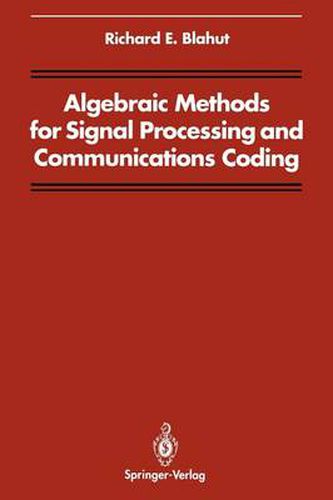
Algorithms for computation are a central part of both digital signal pro cessing and decoders for error-control codes and the central algorithms of the two subjects share many similarities. Each subject makes extensive use of the discrete Fourier transform, of convolutions, and of algorithms for the inversion of Toeplitz systems of equations. Digital signal processing is now an established subject in its own right; it no longer needs to be viewed as a digitized version of analog signal process ing. Algebraic structures are becoming more important to its development. Many of the techniques of digital signal processing are valid in any algebraic field, although in most cases at least part of the problem will naturally lie either in the real field or the complex field because that is where the data originate. In other cases the choice of field for computations may be up to the algorithm designer, who usually chooses the real field or the complex field because of familiarity with it or because it is suitable for the particular application. Still, it is appropriate to catalog the many algebraic fields in a way that is accessible to students of digital signal processing, in hopes of stimulating new applications to engineering tasks.
$9.00 standard shipping within Australia
FREE standard shipping within Australia for orders over $100.00
Express & International shipping calculated at checkout
Stock availability can be subject to change without notice. We recommend calling the shop or contacting our online team to check availability of low stock items. Please see our Shopping Online page for more details.
This title is printed to order. This book may have been self-published. If so, we cannot guarantee the quality of the content. In the main most books will have gone through the editing process however some may not. We therefore suggest that you be aware of this before ordering this book. If in doubt check either the author or publisher’s details as we are unable to accept any returns unless they are faulty. Please contact us if you have any questions.
Algorithms for computation are a central part of both digital signal pro cessing and decoders for error-control codes and the central algorithms of the two subjects share many similarities. Each subject makes extensive use of the discrete Fourier transform, of convolutions, and of algorithms for the inversion of Toeplitz systems of equations. Digital signal processing is now an established subject in its own right; it no longer needs to be viewed as a digitized version of analog signal process ing. Algebraic structures are becoming more important to its development. Many of the techniques of digital signal processing are valid in any algebraic field, although in most cases at least part of the problem will naturally lie either in the real field or the complex field because that is where the data originate. In other cases the choice of field for computations may be up to the algorithm designer, who usually chooses the real field or the complex field because of familiarity with it or because it is suitable for the particular application. Still, it is appropriate to catalog the many algebraic fields in a way that is accessible to students of digital signal processing, in hopes of stimulating new applications to engineering tasks.
Search our extensive online catalogue.
