Readings Newsletter
Become a Readings Member to make your shopping experience even easier.
Sign in or sign up for free!
You’re not far away from qualifying for FREE standard shipping within Australia
You’ve qualified for FREE standard shipping within Australia
The cart is loading…


This title is printed to order. This book may have been self-published. If so, we cannot guarantee the quality of the content. In the main most books will have gone through the editing process however some may not. We therefore suggest that you be aware of this before ordering this book. If in doubt check either the author or publisher’s details as we are unable to accept any returns unless they are faulty. Please contact us if you have any questions.
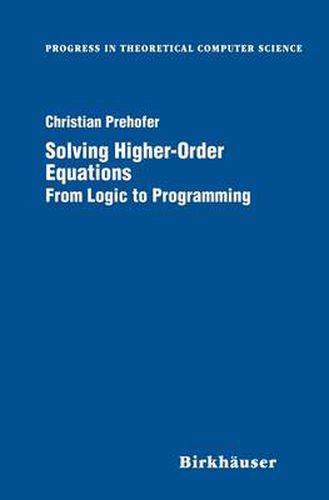
This monograph develops techniques for equational reasoning in higher-order logic. Due to its expressiveness, higher-order logic is used for specification and verification of hardware, software, and mathematics. In these applica tions, higher-order logic provides the necessary level of abstraction for con cise and natural formulations. The main assets of higher-order logic are quan tification over functions or predicates and its abstraction mechanism. These allow one to represent quantification in formulas and other variable-binding constructs. In this book, we focus on equational logic as a fundamental and natural concept in computer science and mathematics. We present calculi for equa tional reasoning modulo higher-order equations presented as rewrite rules. This is followed by a systematic development from general equational rea soning towards effective calculi for declarative programming in higher-order logic and A-calculus. This aims at integrating and generalizing declarative programming models such as functional and logic programming. In these two prominent declarative computation models we can view a program as a logical theory and a computation as a deduction.
$9.00 standard shipping within Australia
FREE standard shipping within Australia for orders over $100.00
Express & International shipping calculated at checkout
Stock availability can be subject to change without notice. We recommend calling the shop or contacting our online team to check availability of low stock items. Please see our Shopping Online page for more details.
This title is printed to order. This book may have been self-published. If so, we cannot guarantee the quality of the content. In the main most books will have gone through the editing process however some may not. We therefore suggest that you be aware of this before ordering this book. If in doubt check either the author or publisher’s details as we are unable to accept any returns unless they are faulty. Please contact us if you have any questions.
This monograph develops techniques for equational reasoning in higher-order logic. Due to its expressiveness, higher-order logic is used for specification and verification of hardware, software, and mathematics. In these applica tions, higher-order logic provides the necessary level of abstraction for con cise and natural formulations. The main assets of higher-order logic are quan tification over functions or predicates and its abstraction mechanism. These allow one to represent quantification in formulas and other variable-binding constructs. In this book, we focus on equational logic as a fundamental and natural concept in computer science and mathematics. We present calculi for equa tional reasoning modulo higher-order equations presented as rewrite rules. This is followed by a systematic development from general equational rea soning towards effective calculi for declarative programming in higher-order logic and A-calculus. This aims at integrating and generalizing declarative programming models such as functional and logic programming. In these two prominent declarative computation models we can view a program as a logical theory and a computation as a deduction.
Search our extensive online catalogue.
