Readings Newsletter
Become a Readings Member to make your shopping experience even easier.
Sign in or sign up for free!
You’re not far away from qualifying for FREE standard shipping within Australia
You’ve qualified for FREE standard shipping within Australia
The cart is loading…


This title is printed to order. This book may have been self-published. If so, we cannot guarantee the quality of the content. In the main most books will have gone through the editing process however some may not. We therefore suggest that you be aware of this before ordering this book. If in doubt check either the author or publisher’s details as we are unable to accept any returns unless they are faulty. Please contact us if you have any questions.
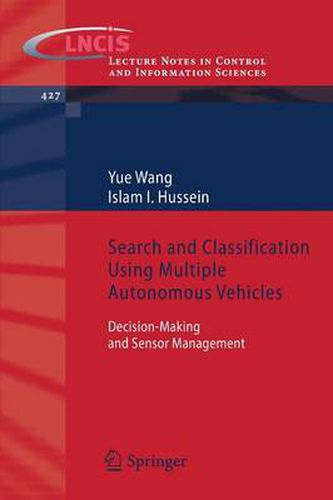
Search and Classification Using Multiple Autonomous Vehicles provides a comprehensive study of decision-making strategies for domain search and object classification using multiple autonomous vehicles (MAV) under both deterministic and probabilistic frameworks. It serves as a first discussion of the problem of effective resource allocation using MAV with sensing limitations, i.e., for search and classification missions over large-scale domains, or when there are far more objects to be found and classified than there are autonomous vehicles available. Under such scenarios, search and classification compete for limited sensing resources. This is because search requires vehicle mobility while classification restricts the vehicles to the vicinity of any objects found. The authors develop decision-making strategies to choose between these competing tasks and vehicle-motion-control laws to achieve the proposed management scheme. Deterministic Lyapunov-based, probabilistic Bayesian-based, and risk-based decision-making strategies and sensor-management schemes are created in sequence. Modeling and analysis include rigorous mathematical proofs of the proposed theorems and the practical consideration of limited sensing resources and observation costs. A survey of the well-developed coverage control problem is also provided as a foundation of search algorithms within the overall decision-making strategies. Applications in both underwater sampling and space-situational awareness are investigated in detail. The control strategies proposed in each chapter are followed by illustrative simulation results and analysis.
Academic researchers and graduate students from aerospace, robotics, mechanical or electrical engineering backgrounds interested in multi-agent coordination and control, in detection and estimation or in Bayes filtration will find this text of interest.
$9.00 standard shipping within Australia
FREE standard shipping within Australia for orders over $100.00
Express & International shipping calculated at checkout
Stock availability can be subject to change without notice. We recommend calling the shop or contacting our online team to check availability of low stock items. Please see our Shopping Online page for more details.
This title is printed to order. This book may have been self-published. If so, we cannot guarantee the quality of the content. In the main most books will have gone through the editing process however some may not. We therefore suggest that you be aware of this before ordering this book. If in doubt check either the author or publisher’s details as we are unable to accept any returns unless they are faulty. Please contact us if you have any questions.
Search and Classification Using Multiple Autonomous Vehicles provides a comprehensive study of decision-making strategies for domain search and object classification using multiple autonomous vehicles (MAV) under both deterministic and probabilistic frameworks. It serves as a first discussion of the problem of effective resource allocation using MAV with sensing limitations, i.e., for search and classification missions over large-scale domains, or when there are far more objects to be found and classified than there are autonomous vehicles available. Under such scenarios, search and classification compete for limited sensing resources. This is because search requires vehicle mobility while classification restricts the vehicles to the vicinity of any objects found. The authors develop decision-making strategies to choose between these competing tasks and vehicle-motion-control laws to achieve the proposed management scheme. Deterministic Lyapunov-based, probabilistic Bayesian-based, and risk-based decision-making strategies and sensor-management schemes are created in sequence. Modeling and analysis include rigorous mathematical proofs of the proposed theorems and the practical consideration of limited sensing resources and observation costs. A survey of the well-developed coverage control problem is also provided as a foundation of search algorithms within the overall decision-making strategies. Applications in both underwater sampling and space-situational awareness are investigated in detail. The control strategies proposed in each chapter are followed by illustrative simulation results and analysis.
Academic researchers and graduate students from aerospace, robotics, mechanical or electrical engineering backgrounds interested in multi-agent coordination and control, in detection and estimation or in Bayes filtration will find this text of interest.
Search our extensive online catalogue.
