Readings Newsletter
Become a Readings Member to make your shopping experience even easier.
Sign in or sign up for free!
You’re not far away from qualifying for FREE standard shipping within Australia
You’ve qualified for FREE standard shipping within Australia
The cart is loading…


This title is printed to order. This book may have been self-published. If so, we cannot guarantee the quality of the content. In the main most books will have gone through the editing process however some may not. We therefore suggest that you be aware of this before ordering this book. If in doubt check either the author or publisher’s details as we are unable to accept any returns unless they are faulty. Please contact us if you have any questions.
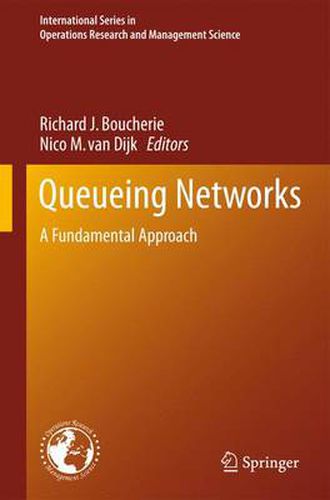
This handbook aims to highlight fundamental, methodological and computational aspects of networks of queues to provide insights and to unify results that can be applied in a more general manner. The handbook is organized into five parts:
Part 1 considers exact analytical results such as of product form type. Topics include characterization of product forms by physical balance concepts and simple traffic flow equations, classes of service and queue disciplines that allow a product form, a unified description of product forms for discrete time queueing networks, insights for insensitivity, and aggregation and decomposition results that allow sub networks to be aggregated into single nodes to reduce computational burden.
Part 2 looks at monotonicity and comparison results such as for computational simplification by either of two approaches: stochastic monotonicity and ordering results based on the ordering of the process generators, and comparison results and explicit error bounds based on an underlying Markov reward structure leading to ordering of expectations of performance measures.
Part 3 presents diffusion and fluid results. It specifically looks at the fluid regime and the diffusion regime. Both of these are illustrated through fluid limits for the analysis of system stability, diffusion approximations for multi-server systems, and a system fed by Gaussian traffic.
Part 4 illustrates computational and approximate results through the classical MVA (mean value analysis) and QNA (queueing network analyzer) for computing mean and variance of performance measures such as queue lengths and sojourn times; numerical approximation of response time distributions; and approximate decomposition results for large open queueing networks.
Part 5 enlightens selected applications as loss networks originating from circuit switched telecommunications applications, capacity sharing originating from packet switching in data networks, and a hospital application that is of growing present day interest.
The book shows that the intertwined progress of theory and practice will remain to be most intriguing and will continue to be the basis of further developments in queueing networks.
$9.00 standard shipping within Australia
FREE standard shipping within Australia for orders over $100.00
Express & International shipping calculated at checkout
Stock availability can be subject to change without notice. We recommend calling the shop or contacting our online team to check availability of low stock items. Please see our Shopping Online page for more details.
This title is printed to order. This book may have been self-published. If so, we cannot guarantee the quality of the content. In the main most books will have gone through the editing process however some may not. We therefore suggest that you be aware of this before ordering this book. If in doubt check either the author or publisher’s details as we are unable to accept any returns unless they are faulty. Please contact us if you have any questions.
This handbook aims to highlight fundamental, methodological and computational aspects of networks of queues to provide insights and to unify results that can be applied in a more general manner. The handbook is organized into five parts:
Part 1 considers exact analytical results such as of product form type. Topics include characterization of product forms by physical balance concepts and simple traffic flow equations, classes of service and queue disciplines that allow a product form, a unified description of product forms for discrete time queueing networks, insights for insensitivity, and aggregation and decomposition results that allow sub networks to be aggregated into single nodes to reduce computational burden.
Part 2 looks at monotonicity and comparison results such as for computational simplification by either of two approaches: stochastic monotonicity and ordering results based on the ordering of the process generators, and comparison results and explicit error bounds based on an underlying Markov reward structure leading to ordering of expectations of performance measures.
Part 3 presents diffusion and fluid results. It specifically looks at the fluid regime and the diffusion regime. Both of these are illustrated through fluid limits for the analysis of system stability, diffusion approximations for multi-server systems, and a system fed by Gaussian traffic.
Part 4 illustrates computational and approximate results through the classical MVA (mean value analysis) and QNA (queueing network analyzer) for computing mean and variance of performance measures such as queue lengths and sojourn times; numerical approximation of response time distributions; and approximate decomposition results for large open queueing networks.
Part 5 enlightens selected applications as loss networks originating from circuit switched telecommunications applications, capacity sharing originating from packet switching in data networks, and a hospital application that is of growing present day interest.
The book shows that the intertwined progress of theory and practice will remain to be most intriguing and will continue to be the basis of further developments in queueing networks.
Search our extensive online catalogue.
