Readings Newsletter
Become a Readings Member to make your shopping experience even easier.
Sign in or sign up for free!
You’re not far away from qualifying for FREE standard shipping within Australia
You’ve qualified for FREE standard shipping within Australia
The cart is loading…


This title is printed to order. This book may have been self-published. If so, we cannot guarantee the quality of the content. In the main most books will have gone through the editing process however some may not. We therefore suggest that you be aware of this before ordering this book. If in doubt check either the author or publisher’s details as we are unable to accept any returns unless they are faulty. Please contact us if you have any questions.
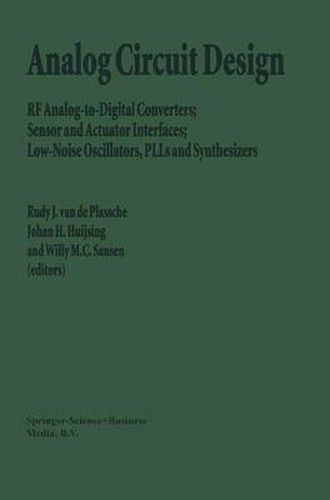
This volume of Analog Circuit Design concentrates on three topics: RF Analog-to-Digital Converters; Sensor and Actuator Interfaces; Low-Noise Oscillators, PLLs and Synthesizers. The book comprises six papers on each topic written by internationally recognised experts. These papers are tutorial in nature and together make a substantial contribution to improving the design of analog circuits. The book is divided into three parts: Part I, RF Analog-to-Digital Converters, the application of digital techniques to process analog modulated rf signals in radio receivers requires high linearity and high-resolution analog-to-digital converters. In portable applications these converters must have an extremely low-power consumption to allow a long standby time. In low-cost signal processing applications these converters are combined with a digital signal processing system onto a single chip. Today digital signal processing systems use advanced CMOS technologies requiring the analog-to-digital converter to be implemented in the same (digital) technology. Such an implementation requires special circuit techniques. Furthermore the susceptibility of converters to ground bounce or digital noise is an important design criterion. In this part different converters and conversion techniques are described that are optimized for receiver applications. Part II, Sensor and Actuator Interfaces, interfaces for sensors and actuators shape the gates through which information is acquired from the real world into digital information systems, and vice versa. The interfaces should include analog signal conditioning, analog-to-digital conversion, digital bus interfaces and data-acquisition networks. To simplify the use of data-acquisition systems additional features should be incorporated, like self-test, and calibration. To make these goals economically feasible, these functions should be integrated, preferably with the sensor, on a single chip. This part describes the latest techniques in sensor and actuator interface design. Part III, Low-Noise Oscillators, PLLs and Synthesizers, the phase noise of the receiver’s local oscillator limits the immunity against interfering signals. Therefore it has become the most important specification of the local oscillators of all integrated transceivers. Frequency synthesizers for digital tuning in portable radios require extremely low phase noise for the same reason. This part describes designs and architectures which give rise to very low phase noise. Analog Circuit Design is an essential reference source for analog design engineers and researchers wishing to keep abreast with the latest developments in the field. The tutorial nature of the contributions also makes it suitable for use in an advanced course.
$9.00 standard shipping within Australia
FREE standard shipping within Australia for orders over $100.00
Express & International shipping calculated at checkout
Stock availability can be subject to change without notice. We recommend calling the shop or contacting our online team to check availability of low stock items. Please see our Shopping Online page for more details.
This title is printed to order. This book may have been self-published. If so, we cannot guarantee the quality of the content. In the main most books will have gone through the editing process however some may not. We therefore suggest that you be aware of this before ordering this book. If in doubt check either the author or publisher’s details as we are unable to accept any returns unless they are faulty. Please contact us if you have any questions.
This volume of Analog Circuit Design concentrates on three topics: RF Analog-to-Digital Converters; Sensor and Actuator Interfaces; Low-Noise Oscillators, PLLs and Synthesizers. The book comprises six papers on each topic written by internationally recognised experts. These papers are tutorial in nature and together make a substantial contribution to improving the design of analog circuits. The book is divided into three parts: Part I, RF Analog-to-Digital Converters, the application of digital techniques to process analog modulated rf signals in radio receivers requires high linearity and high-resolution analog-to-digital converters. In portable applications these converters must have an extremely low-power consumption to allow a long standby time. In low-cost signal processing applications these converters are combined with a digital signal processing system onto a single chip. Today digital signal processing systems use advanced CMOS technologies requiring the analog-to-digital converter to be implemented in the same (digital) technology. Such an implementation requires special circuit techniques. Furthermore the susceptibility of converters to ground bounce or digital noise is an important design criterion. In this part different converters and conversion techniques are described that are optimized for receiver applications. Part II, Sensor and Actuator Interfaces, interfaces for sensors and actuators shape the gates through which information is acquired from the real world into digital information systems, and vice versa. The interfaces should include analog signal conditioning, analog-to-digital conversion, digital bus interfaces and data-acquisition networks. To simplify the use of data-acquisition systems additional features should be incorporated, like self-test, and calibration. To make these goals economically feasible, these functions should be integrated, preferably with the sensor, on a single chip. This part describes the latest techniques in sensor and actuator interface design. Part III, Low-Noise Oscillators, PLLs and Synthesizers, the phase noise of the receiver’s local oscillator limits the immunity against interfering signals. Therefore it has become the most important specification of the local oscillators of all integrated transceivers. Frequency synthesizers for digital tuning in portable radios require extremely low phase noise for the same reason. This part describes designs and architectures which give rise to very low phase noise. Analog Circuit Design is an essential reference source for analog design engineers and researchers wishing to keep abreast with the latest developments in the field. The tutorial nature of the contributions also makes it suitable for use in an advanced course.
Search our extensive online catalogue.
