Readings Newsletter
Become a Readings Member to make your shopping experience even easier.
Sign in or sign up for free!
You’re not far away from qualifying for FREE standard shipping within Australia
You’ve qualified for FREE standard shipping within Australia
The cart is loading…


This title is printed to order. This book may have been self-published. If so, we cannot guarantee the quality of the content. In the main most books will have gone through the editing process however some may not. We therefore suggest that you be aware of this before ordering this book. If in doubt check either the author or publisher’s details as we are unable to accept any returns unless they are faulty. Please contact us if you have any questions.
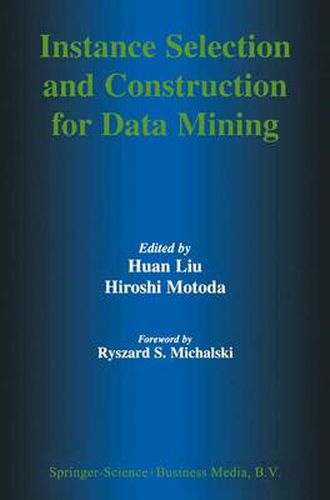
The ability to analyze and understand massive data sets lags far behind the ability to gather and store the data. To meet this challenge, knowledge discovery and data mining (KDD) is growing rapidly as an emerging field. However, no matter how powerful computers are now or will be in the future, KDD researchers and practitioners must consider how to manage ever-growing data which is, ironically, due to the extensive use of computers and ease of data collection with computers. Many different approaches have been used to address the data explosion issue, such as algorithm scale-up and data reduction. Instance, example, or tuple selection pertains to methods or algorithms that select or search for a representative portion of data that can fulfill a KDD task as if the whole data is used. Instance selection is directly related to data reduction and becomes increasingly important in many KDD applications due to the need for processing efficiency and/or storage efficiency. One of the major means of instance selection is sampling whereby a sample is selected for testing and analysis, and randomness is a key element in the process. Instance selection also covers methods that require search. Examples can be found in density estimation (finding the representative instances - data points - for a cluster); boundary hunting (finding the critical instances to form boundaries to differentiate data points of different classes); and data squashing (producing weighted new data with equivalent sufficient statistics). Other important issues related to instance selection extend to unwanted precision, focusing, concept drifts, noise/outlier removal, data smoothing, etc. Instance Selection and Construction for Data Mining brings researchers and practitioners together to report new developments and applications, to share hard-learned experiences in order to avoid similar pitfalls, and to shed light on the future development of instance selection. This volume serves as a comprehensive reference for graduate students, practitioners and researchers in KDD.
$9.00 standard shipping within Australia
FREE standard shipping within Australia for orders over $100.00
Express & International shipping calculated at checkout
Stock availability can be subject to change without notice. We recommend calling the shop or contacting our online team to check availability of low stock items. Please see our Shopping Online page for more details.
This title is printed to order. This book may have been self-published. If so, we cannot guarantee the quality of the content. In the main most books will have gone through the editing process however some may not. We therefore suggest that you be aware of this before ordering this book. If in doubt check either the author or publisher’s details as we are unable to accept any returns unless they are faulty. Please contact us if you have any questions.
The ability to analyze and understand massive data sets lags far behind the ability to gather and store the data. To meet this challenge, knowledge discovery and data mining (KDD) is growing rapidly as an emerging field. However, no matter how powerful computers are now or will be in the future, KDD researchers and practitioners must consider how to manage ever-growing data which is, ironically, due to the extensive use of computers and ease of data collection with computers. Many different approaches have been used to address the data explosion issue, such as algorithm scale-up and data reduction. Instance, example, or tuple selection pertains to methods or algorithms that select or search for a representative portion of data that can fulfill a KDD task as if the whole data is used. Instance selection is directly related to data reduction and becomes increasingly important in many KDD applications due to the need for processing efficiency and/or storage efficiency. One of the major means of instance selection is sampling whereby a sample is selected for testing and analysis, and randomness is a key element in the process. Instance selection also covers methods that require search. Examples can be found in density estimation (finding the representative instances - data points - for a cluster); boundary hunting (finding the critical instances to form boundaries to differentiate data points of different classes); and data squashing (producing weighted new data with equivalent sufficient statistics). Other important issues related to instance selection extend to unwanted precision, focusing, concept drifts, noise/outlier removal, data smoothing, etc. Instance Selection and Construction for Data Mining brings researchers and practitioners together to report new developments and applications, to share hard-learned experiences in order to avoid similar pitfalls, and to shed light on the future development of instance selection. This volume serves as a comprehensive reference for graduate students, practitioners and researchers in KDD.
Search our extensive online catalogue.
