Readings Newsletter
Become a Readings Member to make your shopping experience even easier.
Sign in or sign up for free!
You’re not far away from qualifying for FREE standard shipping within Australia
You’ve qualified for FREE standard shipping within Australia
The cart is loading…


This title is printed to order. This book may have been self-published. If so, we cannot guarantee the quality of the content. In the main most books will have gone through the editing process however some may not. We therefore suggest that you be aware of this before ordering this book. If in doubt check either the author or publisher’s details as we are unable to accept any returns unless they are faulty. Please contact us if you have any questions.
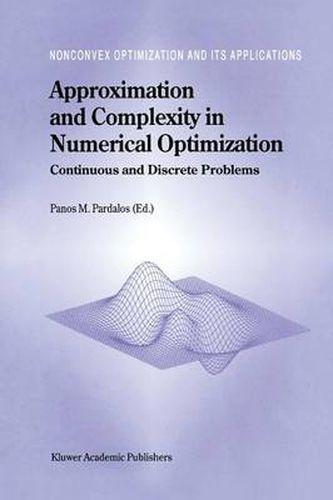
There has been much recent progress in approximation algorithms for nonconvex continuous and discrete problems, from both a theoretical and a practical perspective. In discrete (or combinatorial) optimization many approaches have been developed recently that link the discrete universe to the continuous universe through geometric, analytic, and algebraic techniques. Such techniques include global optimization formulations, semidefinite programming, and spectral theory. As a result new approximate algorithms have been discovered and many new computational approaches have been developed. Similarly, for many continuous nonconvex optimization problems, new approximate algorithms have been developed based on semidefinite programming and new randomization techniques. On the other hand, computational complexity, originating from the interactions between computer science and numerical optimization, is one of the major theories that have revolutionized the approach to solving optimization problems and to analyzing their intrinsic difficulty. The main focus of complexity is the study of whether existing algorithms are efficient for the solution of problems, and which problems are likely to be tractable. The quest for developing efficient algorithms leads also to elegant general approaches for solving optimization problems, and reveals surprising connections among problems and their solutions. The two themes of approximation and complexity pervade this book. Audience: Faculty, graduate students, and researchers in mathematical programming, computer sciences and engineering.
$9.00 standard shipping within Australia
FREE standard shipping within Australia for orders over $100.00
Express & International shipping calculated at checkout
Stock availability can be subject to change without notice. We recommend calling the shop or contacting our online team to check availability of low stock items. Please see our Shopping Online page for more details.
This title is printed to order. This book may have been self-published. If so, we cannot guarantee the quality of the content. In the main most books will have gone through the editing process however some may not. We therefore suggest that you be aware of this before ordering this book. If in doubt check either the author or publisher’s details as we are unable to accept any returns unless they are faulty. Please contact us if you have any questions.
There has been much recent progress in approximation algorithms for nonconvex continuous and discrete problems, from both a theoretical and a practical perspective. In discrete (or combinatorial) optimization many approaches have been developed recently that link the discrete universe to the continuous universe through geometric, analytic, and algebraic techniques. Such techniques include global optimization formulations, semidefinite programming, and spectral theory. As a result new approximate algorithms have been discovered and many new computational approaches have been developed. Similarly, for many continuous nonconvex optimization problems, new approximate algorithms have been developed based on semidefinite programming and new randomization techniques. On the other hand, computational complexity, originating from the interactions between computer science and numerical optimization, is one of the major theories that have revolutionized the approach to solving optimization problems and to analyzing their intrinsic difficulty. The main focus of complexity is the study of whether existing algorithms are efficient for the solution of problems, and which problems are likely to be tractable. The quest for developing efficient algorithms leads also to elegant general approaches for solving optimization problems, and reveals surprising connections among problems and their solutions. The two themes of approximation and complexity pervade this book. Audience: Faculty, graduate students, and researchers in mathematical programming, computer sciences and engineering.
Search our extensive online catalogue.
