Readings Newsletter
Become a Readings Member to make your shopping experience even easier.
Sign in or sign up for free!
You’re not far away from qualifying for FREE standard shipping within Australia
You’ve qualified for FREE standard shipping within Australia
The cart is loading…


This title is printed to order. This book may have been self-published. If so, we cannot guarantee the quality of the content. In the main most books will have gone through the editing process however some may not. We therefore suggest that you be aware of this before ordering this book. If in doubt check either the author or publisher’s details as we are unable to accept any returns unless they are faulty. Please contact us if you have any questions.
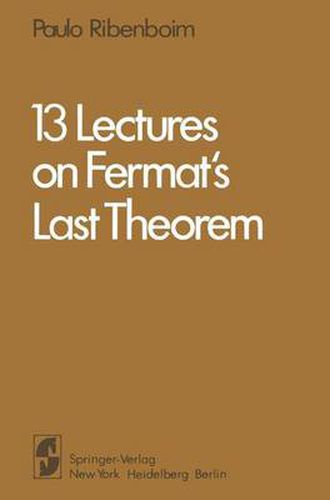
Fermat’s problem, also ealled Fermat’s last theorem, has attraeted the attention of mathematieians far more than three eenturies. Many clever methods have been devised to attaek the problem, and many beautiful theories have been ereated with the aim of proving the theorem. Yet, despite all the attempts, the question remains unanswered. The topie is presented in the form of leetures, where I survey the main lines of work on the problem. In the first two leetures, there is a very brief deseription of the early history , as well as a seleetion of a few of the more representative reeent results. In the leetures whieh follow, I examine in sue- eession the main theories eonneeted with the problem. The last two lee tu res are about analogues to Fermat’s theorem. Some of these leetures were aetually given, in a shorter version, at the Institut Henri Poineare, in Paris, as well as at Queen’s University, in 1977. I endeavoured to produee a text, readable by mathematieians in general, and not only by speeialists in number theory. However, due to a limitation in size, I am aware that eertain points will appear sketehy. Another book on Fermat’s theorem, now in preparation, will eontain a eonsiderable amount of the teehnieal developments omitted here. It will serve those who wish to learn these matters in depth and, I hope, it will clarify and eomplement the present volume.
$9.00 standard shipping within Australia
FREE standard shipping within Australia for orders over $100.00
Express & International shipping calculated at checkout
Stock availability can be subject to change without notice. We recommend calling the shop or contacting our online team to check availability of low stock items. Please see our Shopping Online page for more details.
This title is printed to order. This book may have been self-published. If so, we cannot guarantee the quality of the content. In the main most books will have gone through the editing process however some may not. We therefore suggest that you be aware of this before ordering this book. If in doubt check either the author or publisher’s details as we are unable to accept any returns unless they are faulty. Please contact us if you have any questions.
Fermat’s problem, also ealled Fermat’s last theorem, has attraeted the attention of mathematieians far more than three eenturies. Many clever methods have been devised to attaek the problem, and many beautiful theories have been ereated with the aim of proving the theorem. Yet, despite all the attempts, the question remains unanswered. The topie is presented in the form of leetures, where I survey the main lines of work on the problem. In the first two leetures, there is a very brief deseription of the early history , as well as a seleetion of a few of the more representative reeent results. In the leetures whieh follow, I examine in sue- eession the main theories eonneeted with the problem. The last two lee tu res are about analogues to Fermat’s theorem. Some of these leetures were aetually given, in a shorter version, at the Institut Henri Poineare, in Paris, as well as at Queen’s University, in 1977. I endeavoured to produee a text, readable by mathematieians in general, and not only by speeialists in number theory. However, due to a limitation in size, I am aware that eertain points will appear sketehy. Another book on Fermat’s theorem, now in preparation, will eontain a eonsiderable amount of the teehnieal developments omitted here. It will serve those who wish to learn these matters in depth and, I hope, it will clarify and eomplement the present volume.
Search our extensive online catalogue.
