Readings Newsletter
Become a Readings Member to make your shopping experience even easier.
Sign in or sign up for free!
You’re not far away from qualifying for FREE standard shipping within Australia
You’ve qualified for FREE standard shipping within Australia
The cart is loading…


This title is printed to order. This book may have been self-published. If so, we cannot guarantee the quality of the content. In the main most books will have gone through the editing process however some may not. We therefore suggest that you be aware of this before ordering this book. If in doubt check either the author or publisher’s details as we are unable to accept any returns unless they are faulty. Please contact us if you have any questions.
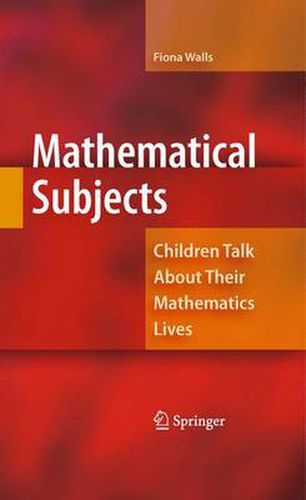
Teaching and learning mathematics is a political act in which children, teachers, parents, and policy makers are made visible as subjects. As they learn about mathematics, children are also learning about themselves - who they are, who they might become. We can choose to listen or not to what children have to say about learning mathematics. Such choices constitute us in relations of power. Mathematical know-how is widely regarded as essential not only to the life chances of individuals, but also to the health of communities and the economic well-being of nations. With the globalisation of education in an increasingly market-oriented world, mathematics has received intensified attention in the first decade of the twenty-first century with a shifting emphasis on utilitarian aspects of mathematics. This is reflected in the reconceptualisation of mathematical competence as mathematical literacy, loosely conceived as those ways of thinking, reasoning and working mathematically that allow us to engage effectively in everyday situations, in many occupations, and the cut and thrust of world economies as active, empowered and participatory citizens. It is no surprise then that mathematics has become one of the most politically charged subjects in primary school curricula worldwide. We are experiencing an unprecedented proliferation of regional and national strategies to establish benchmarks, raise standards, enhance achievement, close gaps, and leave no child behind in mathematics education. Industries have sprung up around the design, administration and monitoring of standardised assessment to measure and compare children’s mathematical achievement against identified benchmarks and each other.
$9.00 standard shipping within Australia
FREE standard shipping within Australia for orders over $100.00
Express & International shipping calculated at checkout
Stock availability can be subject to change without notice. We recommend calling the shop or contacting our online team to check availability of low stock items. Please see our Shopping Online page for more details.
This title is printed to order. This book may have been self-published. If so, we cannot guarantee the quality of the content. In the main most books will have gone through the editing process however some may not. We therefore suggest that you be aware of this before ordering this book. If in doubt check either the author or publisher’s details as we are unable to accept any returns unless they are faulty. Please contact us if you have any questions.
Teaching and learning mathematics is a political act in which children, teachers, parents, and policy makers are made visible as subjects. As they learn about mathematics, children are also learning about themselves - who they are, who they might become. We can choose to listen or not to what children have to say about learning mathematics. Such choices constitute us in relations of power. Mathematical know-how is widely regarded as essential not only to the life chances of individuals, but also to the health of communities and the economic well-being of nations. With the globalisation of education in an increasingly market-oriented world, mathematics has received intensified attention in the first decade of the twenty-first century with a shifting emphasis on utilitarian aspects of mathematics. This is reflected in the reconceptualisation of mathematical competence as mathematical literacy, loosely conceived as those ways of thinking, reasoning and working mathematically that allow us to engage effectively in everyday situations, in many occupations, and the cut and thrust of world economies as active, empowered and participatory citizens. It is no surprise then that mathematics has become one of the most politically charged subjects in primary school curricula worldwide. We are experiencing an unprecedented proliferation of regional and national strategies to establish benchmarks, raise standards, enhance achievement, close gaps, and leave no child behind in mathematics education. Industries have sprung up around the design, administration and monitoring of standardised assessment to measure and compare children’s mathematical achievement against identified benchmarks and each other.
Search our extensive online catalogue.
