Readings Newsletter
Become a Readings Member to make your shopping experience even easier.
Sign in or sign up for free!
You’re not far away from qualifying for FREE standard shipping within Australia
You’ve qualified for FREE standard shipping within Australia
The cart is loading…


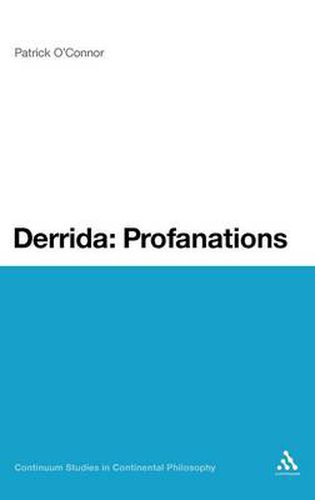
Derrida: Profanations presents a re-appraisal of Jacques Derrida’s deconstruction. If philosophy articulates what it means to be human, then deconstruction, which Patrick O'Connor argues consigns all existence to a mortal, profane and worldly life remains radically philosophical. The assertion demands an analysis of Derrida’s radicalisation of the key philosophers who influenced him, as well as a rebuttal of theological accounts of deconstruction. This book closely examines how the phenomenological lineage is received in deconstruction, especially the relation between deconstruction and Derrida’s radical readings of Hegel, Husserl, Levinas and Heidegger.
This book presents a theorisation of deconstruction as profane, atheistic and egalitarian. It reveals how deconstruction holds the resources to think ontology as a multiplicity of worlds through demonstrates the ways in which Derrida expresses a ‘phenomenology’ which disjoints humans’ orientation to the world. Deconstruction is characterized as radically hubristic. For deconstruction, nothing is sacred. If nothing sustains itself as separate, exclusive or sacrosanct, then nothing can sustain the implementation of its own hierarchy.
$9.00 standard shipping within Australia
FREE standard shipping within Australia for orders over $100.00
Express & International shipping calculated at checkout
Stock availability can be subject to change without notice. We recommend calling the shop or contacting our online team to check availability of low stock items. Please see our Shopping Online page for more details.
Derrida: Profanations presents a re-appraisal of Jacques Derrida’s deconstruction. If philosophy articulates what it means to be human, then deconstruction, which Patrick O'Connor argues consigns all existence to a mortal, profane and worldly life remains radically philosophical. The assertion demands an analysis of Derrida’s radicalisation of the key philosophers who influenced him, as well as a rebuttal of theological accounts of deconstruction. This book closely examines how the phenomenological lineage is received in deconstruction, especially the relation between deconstruction and Derrida’s radical readings of Hegel, Husserl, Levinas and Heidegger.
This book presents a theorisation of deconstruction as profane, atheistic and egalitarian. It reveals how deconstruction holds the resources to think ontology as a multiplicity of worlds through demonstrates the ways in which Derrida expresses a ‘phenomenology’ which disjoints humans’ orientation to the world. Deconstruction is characterized as radically hubristic. For deconstruction, nothing is sacred. If nothing sustains itself as separate, exclusive or sacrosanct, then nothing can sustain the implementation of its own hierarchy.
Search our extensive online catalogue.
