Readings Newsletter
Become a Readings Member to make your shopping experience even easier.
Sign in or sign up for free!
You’re not far away from qualifying for FREE standard shipping within Australia
You’ve qualified for FREE standard shipping within Australia
The cart is loading…


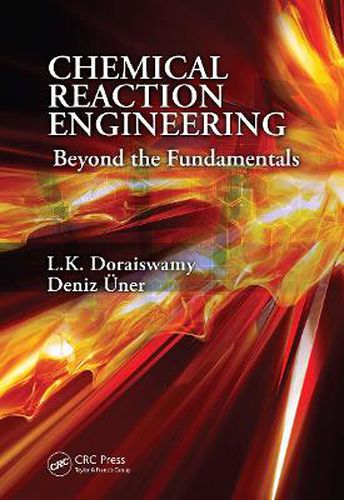
Filling a longstanding gap for graduate courses in the field, Chemical Reaction Engineering: Beyond the Fundamentals covers basic concepts as well as complexities of chemical reaction engineering, including novel techniques for process intensification. The book is divided into three parts: Fundamentals Revisited, Building on Fundamentals, and Beyond the Fundamentals. Part I: Fundamentals Revisited reviews the salient features of an undergraduate course, introducing concepts essential to reactor design, such as mixing, unsteady-state operations, multiple steady states, and complex reactions.
Part II: Building on Fundamentals is devoted to skill building, particularly in the area of catalysis and catalytic reactions. It covers chemical thermodynamics, emphasizing the thermodynamics of adsorption and complex reactions; the fundamentals of chemical kinetics, with special emphasis on microkinetic analysis; and heat and mass transfer effects in catalysis, including transport between phases, transfer across interfaces, and effects of external heat and mass transfer. It also contains a chapter that provides readers with tools for making accurate kinetic measurements and analyzing the data obtained.
Part III: Beyond the Fundamentals presents material not commonly covered in textbooks, addressing aspects of reactors involving more than one phase. It discusses solid catalyzed fluid-phase reactions in fixed-bed and fluidized-bed reactors, gas-solid noncatalytic reactions, reactions involving at least one liquid phase (gas-liquid and liquid-liquid), and multiphase reactions. This section also describes membrane-assisted reactor engineering, combo reactors, homogeneous catalysis, and phase-transfer catalysis. The final chapter provides a perspective on future trends in reaction engineering.
$9.00 standard shipping within Australia
FREE standard shipping within Australia for orders over $100.00
Express & International shipping calculated at checkout
Stock availability can be subject to change without notice. We recommend calling the shop or contacting our online team to check availability of low stock items. Please see our Shopping Online page for more details.
Filling a longstanding gap for graduate courses in the field, Chemical Reaction Engineering: Beyond the Fundamentals covers basic concepts as well as complexities of chemical reaction engineering, including novel techniques for process intensification. The book is divided into three parts: Fundamentals Revisited, Building on Fundamentals, and Beyond the Fundamentals. Part I: Fundamentals Revisited reviews the salient features of an undergraduate course, introducing concepts essential to reactor design, such as mixing, unsteady-state operations, multiple steady states, and complex reactions.
Part II: Building on Fundamentals is devoted to skill building, particularly in the area of catalysis and catalytic reactions. It covers chemical thermodynamics, emphasizing the thermodynamics of adsorption and complex reactions; the fundamentals of chemical kinetics, with special emphasis on microkinetic analysis; and heat and mass transfer effects in catalysis, including transport between phases, transfer across interfaces, and effects of external heat and mass transfer. It also contains a chapter that provides readers with tools for making accurate kinetic measurements and analyzing the data obtained.
Part III: Beyond the Fundamentals presents material not commonly covered in textbooks, addressing aspects of reactors involving more than one phase. It discusses solid catalyzed fluid-phase reactions in fixed-bed and fluidized-bed reactors, gas-solid noncatalytic reactions, reactions involving at least one liquid phase (gas-liquid and liquid-liquid), and multiphase reactions. This section also describes membrane-assisted reactor engineering, combo reactors, homogeneous catalysis, and phase-transfer catalysis. The final chapter provides a perspective on future trends in reaction engineering.
Search our extensive online catalogue.
