Readings Newsletter
Become a Readings Member to make your shopping experience even easier.
Sign in or sign up for free!
You’re not far away from qualifying for FREE standard shipping within Australia
You’ve qualified for FREE standard shipping within Australia
The cart is loading…


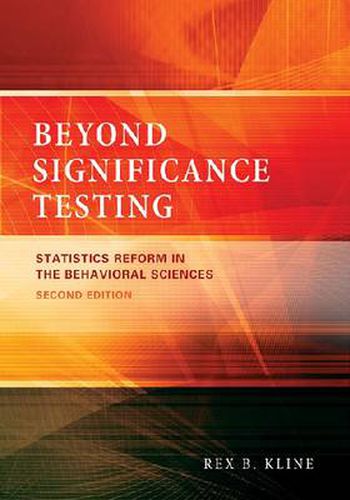
Traditional education in statistics that emphasises significance testing leaves researchers and students ill prepared to understand what their results really mean. Specifically, most researchers and students who do not have strong quantitative backgrounds have difficulty understanding outcomes of statistical tests.
As more and more people become aware of this problem, the emphasis on statistical significance in the reporting of results is declining. Increasingly, researchers are expected to describe the magnitudes and precisions of their findings and also their practical, theoretical, or clinical significance.
This accessibly written book reviews the controversy about significance testing, which has now crossed various disciplines as diverse as psychology, ecology, commerce, education, and biology, among others. It also introduces readers to alternative methods, especially effect size estimation (at both the group and case levels) and interval estimation (confidence intervals) in comparative studies. Basics of bootstrapping and Bayesian estimation are also considered. Research examples from substance abuse, education, learning, and other areas illustrate how to apply these methods.
A companion website promotes learning by providing chapter exercises and sample answers, downloadable raw data files for many research examples, and links to other useful websites.
New to this edition is coverage of robust statistical methods for parameter estimation, effect size estimation, and interval estimation. A new chapter covers the logic and illogic of significance testing. This edition also addresses recent developments such as the new requirements of some journals for the reporting of effect sizes.
$9.00 standard shipping within Australia
FREE standard shipping within Australia for orders over $100.00
Express & International shipping calculated at checkout
Stock availability can be subject to change without notice. We recommend calling the shop or contacting our online team to check availability of low stock items. Please see our Shopping Online page for more details.
Traditional education in statistics that emphasises significance testing leaves researchers and students ill prepared to understand what their results really mean. Specifically, most researchers and students who do not have strong quantitative backgrounds have difficulty understanding outcomes of statistical tests.
As more and more people become aware of this problem, the emphasis on statistical significance in the reporting of results is declining. Increasingly, researchers are expected to describe the magnitudes and precisions of their findings and also their practical, theoretical, or clinical significance.
This accessibly written book reviews the controversy about significance testing, which has now crossed various disciplines as diverse as psychology, ecology, commerce, education, and biology, among others. It also introduces readers to alternative methods, especially effect size estimation (at both the group and case levels) and interval estimation (confidence intervals) in comparative studies. Basics of bootstrapping and Bayesian estimation are also considered. Research examples from substance abuse, education, learning, and other areas illustrate how to apply these methods.
A companion website promotes learning by providing chapter exercises and sample answers, downloadable raw data files for many research examples, and links to other useful websites.
New to this edition is coverage of robust statistical methods for parameter estimation, effect size estimation, and interval estimation. A new chapter covers the logic and illogic of significance testing. This edition also addresses recent developments such as the new requirements of some journals for the reporting of effect sizes.
Search our extensive online catalogue.
