Readings Newsletter
Become a Readings Member to make your shopping experience even easier.
Sign in or sign up for free!
You’re not far away from qualifying for FREE standard shipping within Australia
You’ve qualified for FREE standard shipping within Australia
The cart is loading…


This title is printed to order. This book may have been self-published. If so, we cannot guarantee the quality of the content. In the main most books will have gone through the editing process however some may not. We therefore suggest that you be aware of this before ordering this book. If in doubt check either the author or publisher’s details as we are unable to accept any returns unless they are faulty. Please contact us if you have any questions.
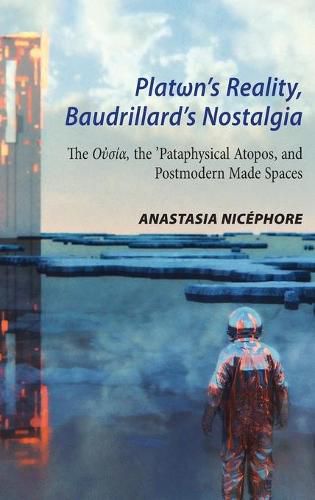
Plat n establishes the principle that literature should cut through the notion of an ideal truth rather than be used as a vehicle for subjective visions and aesthetic tropes by those claiming to be ‘artists.’ To engage with this centrality of human consciousness means to integrate a single source of origin: a Plat nic
. Contemporary hermeneutics draw upon perceptions that the origin is elliptic in postmodern and continental philosophical trains of thought. Moreover, much obscurity arises from Plat n’s own insistence on over-emphasis, and what some philosophers and philologists would consider ‘taut tautology’-which leaves vast amounts of passages in Pre-Socratic manuscripts and Plat nic dialogues open to speculation and subjectivity. Philosophical debates center on the incapability of pinpointing truth, the real, or some definitive and/or tangible self-referential core within an age of pluralism and uncertainty. For this reason, students and scholars in literary theory and postmodern philosophy can gain much from clarifying these ubiquitous areas.Through comparative constructs, the nature of the novel, its evolution over time and inclusion of postmodernist technologies, cyber-capitalism, and accompanying symbols, bring us to question the real and human exigency. Could it be that unlimited experimentation, a kind of ‘pataphysical atopos within and upon a text warrants an aesthetic surface that construes a morally heinous environment? Jean Baudrillard probes this concept by vivifying that a lack of substance-an exponential instability -is invariably transmuting into an altogether absent entity. Within this displacement, this book juxtaposes Plat nic exegesis of the real-the
-and Baudrillardian aporia into current modes of reality for a body politic in acceleration.
$9.00 standard shipping within Australia
FREE standard shipping within Australia for orders over $100.00
Express & International shipping calculated at checkout
Stock availability can be subject to change without notice. We recommend calling the shop or contacting our online team to check availability of low stock items. Please see our Shopping Online page for more details.
This title is printed to order. This book may have been self-published. If so, we cannot guarantee the quality of the content. In the main most books will have gone through the editing process however some may not. We therefore suggest that you be aware of this before ordering this book. If in doubt check either the author or publisher’s details as we are unable to accept any returns unless they are faulty. Please contact us if you have any questions.
Plat n establishes the principle that literature should cut through the notion of an ideal truth rather than be used as a vehicle for subjective visions and aesthetic tropes by those claiming to be ‘artists.’ To engage with this centrality of human consciousness means to integrate a single source of origin: a Plat nic
. Contemporary hermeneutics draw upon perceptions that the origin is elliptic in postmodern and continental philosophical trains of thought. Moreover, much obscurity arises from Plat n’s own insistence on over-emphasis, and what some philosophers and philologists would consider ‘taut tautology’-which leaves vast amounts of passages in Pre-Socratic manuscripts and Plat nic dialogues open to speculation and subjectivity. Philosophical debates center on the incapability of pinpointing truth, the real, or some definitive and/or tangible self-referential core within an age of pluralism and uncertainty. For this reason, students and scholars in literary theory and postmodern philosophy can gain much from clarifying these ubiquitous areas.Through comparative constructs, the nature of the novel, its evolution over time and inclusion of postmodernist technologies, cyber-capitalism, and accompanying symbols, bring us to question the real and human exigency. Could it be that unlimited experimentation, a kind of ‘pataphysical atopos within and upon a text warrants an aesthetic surface that construes a morally heinous environment? Jean Baudrillard probes this concept by vivifying that a lack of substance-an exponential instability -is invariably transmuting into an altogether absent entity. Within this displacement, this book juxtaposes Plat nic exegesis of the real-the
-and Baudrillardian aporia into current modes of reality for a body politic in acceleration.
Search our extensive online catalogue.
