Readings Newsletter
Become a Readings Member to make your shopping experience even easier.
Sign in or sign up for free!
You’re not far away from qualifying for FREE standard shipping within Australia
You’ve qualified for FREE standard shipping within Australia
The cart is loading…


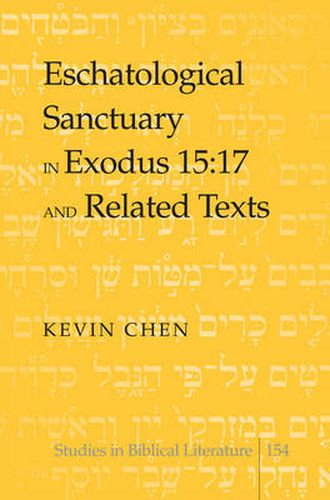
After crossing the Reed Sea, Moses and the Israelites celebrate Yahweh’s victory over the Egyptians in the Song of the Sea (Exod. 15:1-18). Much of the song rejoices over their recent deliverance, but its latter portion anticipates what Yahweh would do for his people in the future. Specifically, he will lead them past enemy nations and plant them on a mountain. Also included in this context is a reference to the sanctuary, O Lord, which your hands have established (v. 17). Commentators throughout the history of interpretation have understood this sanctuary as a reference to Solomon’s temple on Mount Zion.
However, since the temple was eventually destroyed, equating it with a divinely established sanctuary is questionable. Eschatological Sanctuary in Exodus 15:17 and Related Texts argues that the sanctuary mentioned in Exod. 15:17 does not refer to Solomon’s temple or to any other man-made structure but to an eschatological sanctuary distinctively established by divine hands. Such an understanding of this sanctuary impacts the theology of the Pentateuch and provides a reference point for predictions of an eschatological temple in the Prophets and the Writings and for references to unconventional temples in the New Testament.
$9.00 standard shipping within Australia
FREE standard shipping within Australia for orders over $100.00
Express & International shipping calculated at checkout
Stock availability can be subject to change without notice. We recommend calling the shop or contacting our online team to check availability of low stock items. Please see our Shopping Online page for more details.
After crossing the Reed Sea, Moses and the Israelites celebrate Yahweh’s victory over the Egyptians in the Song of the Sea (Exod. 15:1-18). Much of the song rejoices over their recent deliverance, but its latter portion anticipates what Yahweh would do for his people in the future. Specifically, he will lead them past enemy nations and plant them on a mountain. Also included in this context is a reference to the sanctuary, O Lord, which your hands have established (v. 17). Commentators throughout the history of interpretation have understood this sanctuary as a reference to Solomon’s temple on Mount Zion.
However, since the temple was eventually destroyed, equating it with a divinely established sanctuary is questionable. Eschatological Sanctuary in Exodus 15:17 and Related Texts argues that the sanctuary mentioned in Exod. 15:17 does not refer to Solomon’s temple or to any other man-made structure but to an eschatological sanctuary distinctively established by divine hands. Such an understanding of this sanctuary impacts the theology of the Pentateuch and provides a reference point for predictions of an eschatological temple in the Prophets and the Writings and for references to unconventional temples in the New Testament.
Search our extensive online catalogue.
