Readings Newsletter
Become a Readings Member to make your shopping experience even easier.
Sign in or sign up for free!
You’re not far away from qualifying for FREE standard shipping within Australia
You’ve qualified for FREE standard shipping within Australia
The cart is loading…


This title is printed to order. This book may have been self-published. If so, we cannot guarantee the quality of the content. In the main most books will have gone through the editing process however some may not. We therefore suggest that you be aware of this before ordering this book. If in doubt check either the author or publisher’s details as we are unable to accept any returns unless they are faulty. Please contact us if you have any questions.
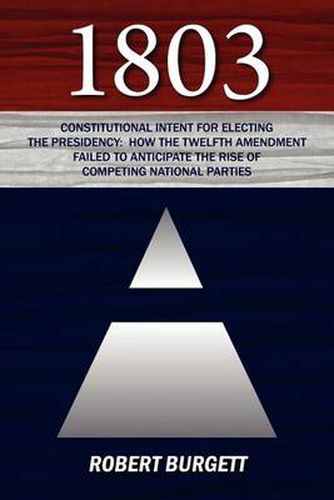
The goal of historians should be to eliminate any personal biases relying solely on facts to capture the most accurate portrayal of a time - to start with facts and allow a thesis to mature naturally, not vice-versa. The passing of the twelfth amendment to the United States Constitution is one of those occurrences where scholars have failed to do their homework. I have yet to find a single source that quotes any one of the many congressmen engaged in drafting the twelfth amendment; the U.S. Code, in 2010, referenced just one article pertaining to the twelfth amendment, Thomas Jefferson Counts himself into the Presidency, 2004. I found that the current understanding of twelfth amendment origins is in great disharmony with historical facts. This has left many without a clear understanding of the issue. This paper challenges the currently accepted view that Article II of the United States Constitution failed to account for a rise of competing national parties. I contend that the twelfth amendment passed Congress in order to prevent the rise of competing national parties. This paper answers the question: Which electoral method, Article II or the twelfth amendment, accounts for a rise of competing national parties? To bring the reader into a time where states are not yet united, I use a hypothetical 2012 North-South American Union to put the issue in its proper perspective. I use, as proofs, electoral results and statements of belief from prominent statesmen like Washington, Jefferson, and Adams; constitutional drafters - Madison, John Rutledge, Charles Pinckney, Robert Yates, Edmond Randolph, Oliver Ellsworth, Morris, and Peirce Butler; congressmen like Abraham Baldwin, George Thatcher, John Smilie, John Randolph, Robert Waln, Robert Harper, Harrison Gray Otis, John Brown, Henry Lee, Michael Leib, William Hill; and those who debated the twelfth amendment - James Hillhouse, Uriah Tracy, William Plumer, Wilson C. Nicholas, John Q. Adams, John Taylor, Peirce Butler (a Drafter abovementioned), Samuel White, and Jonathon Dayton.
$9.00 standard shipping within Australia
FREE standard shipping within Australia for orders over $100.00
Express & International shipping calculated at checkout
Stock availability can be subject to change without notice. We recommend calling the shop or contacting our online team to check availability of low stock items. Please see our Shopping Online page for more details.
This title is printed to order. This book may have been self-published. If so, we cannot guarantee the quality of the content. In the main most books will have gone through the editing process however some may not. We therefore suggest that you be aware of this before ordering this book. If in doubt check either the author or publisher’s details as we are unable to accept any returns unless they are faulty. Please contact us if you have any questions.
The goal of historians should be to eliminate any personal biases relying solely on facts to capture the most accurate portrayal of a time - to start with facts and allow a thesis to mature naturally, not vice-versa. The passing of the twelfth amendment to the United States Constitution is one of those occurrences where scholars have failed to do their homework. I have yet to find a single source that quotes any one of the many congressmen engaged in drafting the twelfth amendment; the U.S. Code, in 2010, referenced just one article pertaining to the twelfth amendment, Thomas Jefferson Counts himself into the Presidency, 2004. I found that the current understanding of twelfth amendment origins is in great disharmony with historical facts. This has left many without a clear understanding of the issue. This paper challenges the currently accepted view that Article II of the United States Constitution failed to account for a rise of competing national parties. I contend that the twelfth amendment passed Congress in order to prevent the rise of competing national parties. This paper answers the question: Which electoral method, Article II or the twelfth amendment, accounts for a rise of competing national parties? To bring the reader into a time where states are not yet united, I use a hypothetical 2012 North-South American Union to put the issue in its proper perspective. I use, as proofs, electoral results and statements of belief from prominent statesmen like Washington, Jefferson, and Adams; constitutional drafters - Madison, John Rutledge, Charles Pinckney, Robert Yates, Edmond Randolph, Oliver Ellsworth, Morris, and Peirce Butler; congressmen like Abraham Baldwin, George Thatcher, John Smilie, John Randolph, Robert Waln, Robert Harper, Harrison Gray Otis, John Brown, Henry Lee, Michael Leib, William Hill; and those who debated the twelfth amendment - James Hillhouse, Uriah Tracy, William Plumer, Wilson C. Nicholas, John Q. Adams, John Taylor, Peirce Butler (a Drafter abovementioned), Samuel White, and Jonathon Dayton.
Search our extensive online catalogue.
