Readings Newsletter
Become a Readings Member to make your shopping experience even easier.
Sign in or sign up for free!
You’re not far away from qualifying for FREE standard shipping within Australia
You’ve qualified for FREE standard shipping within Australia
The cart is loading…


This title is printed to order. This book may have been self-published. If so, we cannot guarantee the quality of the content. In the main most books will have gone through the editing process however some may not. We therefore suggest that you be aware of this before ordering this book. If in doubt check either the author or publisher’s details as we are unable to accept any returns unless they are faulty. Please contact us if you have any questions.
Risk control, capital allocation, and realistic derivative pricing and hedging are critical concerns for major financial institutions and individual traders alike. Events from the collapse of Lehman Brothers to the Greek sovereign debt crisis demonstrate the urgent and abiding need for statistical tools adequate to measure and anticipate the amplitude of potential swings in the financial markets-from ordinary stock price and interest rate moves, to defaults, to those increasingly frequent rare events fashionably called black swan events. Yet many on Wall Street continue to rely on standard models based on artificially simplified assumptions that can lead to systematic (and sometimes catastrophic) underestimation of real risks.
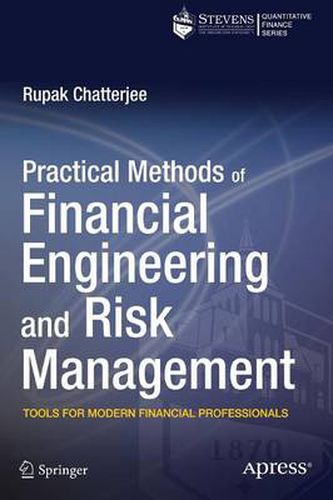
In Practical Methods of Financial Engineering and Risk Management, Dr. Rupak Chatterjee- former director of the multi-asset quantitative research group at Citi-introduces finance professionals and advanced students to the latest concepts, tools, valuation techniques, and analytic measures being deployed by the more discerning and responsive Wall Street practitioners, on all operational scales from day trading to institutional strategy, to model and analyze more faithfully the real behavior and risk exposure of financial markets in the cold light of the post-2008 realities. Until one masters this modern skill set, one cannot allocate risk capital properly, price and hedge derivative securities realistically, or risk-manage positions from the multiple perspectives of market risk, credit risk, counterparty risk, and systemic risk.
The book assumes a working knowledge of calculus, statistics, and Excel, but it teaches techniques from statistical analysis, probability, and stochastic processes sufficient to enable the reader to calibrate probability distributions and create the simulations that are used on Wall Street to valuate various financial instruments correctly, model the risk dimensions of trading strategies, and perform the numerically intensive analysis of risk measures required by various regulatory agencies.
$9.00 standard shipping within Australia
FREE standard shipping within Australia for orders over $100.00
Express & International shipping calculated at checkout
Stock availability can be subject to change without notice. We recommend calling the shop or contacting our online team to check availability of low stock items. Please see our Shopping Online page for more details.
This title is printed to order. This book may have been self-published. If so, we cannot guarantee the quality of the content. In the main most books will have gone through the editing process however some may not. We therefore suggest that you be aware of this before ordering this book. If in doubt check either the author or publisher’s details as we are unable to accept any returns unless they are faulty. Please contact us if you have any questions.
Risk control, capital allocation, and realistic derivative pricing and hedging are critical concerns for major financial institutions and individual traders alike. Events from the collapse of Lehman Brothers to the Greek sovereign debt crisis demonstrate the urgent and abiding need for statistical tools adequate to measure and anticipate the amplitude of potential swings in the financial markets-from ordinary stock price and interest rate moves, to defaults, to those increasingly frequent rare events fashionably called black swan events. Yet many on Wall Street continue to rely on standard models based on artificially simplified assumptions that can lead to systematic (and sometimes catastrophic) underestimation of real risks.
In Practical Methods of Financial Engineering and Risk Management, Dr. Rupak Chatterjee- former director of the multi-asset quantitative research group at Citi-introduces finance professionals and advanced students to the latest concepts, tools, valuation techniques, and analytic measures being deployed by the more discerning and responsive Wall Street practitioners, on all operational scales from day trading to institutional strategy, to model and analyze more faithfully the real behavior and risk exposure of financial markets in the cold light of the post-2008 realities. Until one masters this modern skill set, one cannot allocate risk capital properly, price and hedge derivative securities realistically, or risk-manage positions from the multiple perspectives of market risk, credit risk, counterparty risk, and systemic risk.
The book assumes a working knowledge of calculus, statistics, and Excel, but it teaches techniques from statistical analysis, probability, and stochastic processes sufficient to enable the reader to calibrate probability distributions and create the simulations that are used on Wall Street to valuate various financial instruments correctly, model the risk dimensions of trading strategies, and perform the numerically intensive analysis of risk measures required by various regulatory agencies.
Search our extensive online catalogue.
