Readings Newsletter
Become a Readings Member to make your shopping experience even easier.
Sign in or sign up for free!
You’re not far away from qualifying for FREE standard shipping within Australia
You’ve qualified for FREE standard shipping within Australia
The cart is loading…


This title is printed to order. This book may have been self-published. If so, we cannot guarantee the quality of the content. In the main most books will have gone through the editing process however some may not. We therefore suggest that you be aware of this before ordering this book. If in doubt check either the author or publisher’s details as we are unable to accept any returns unless they are faulty. Please contact us if you have any questions.
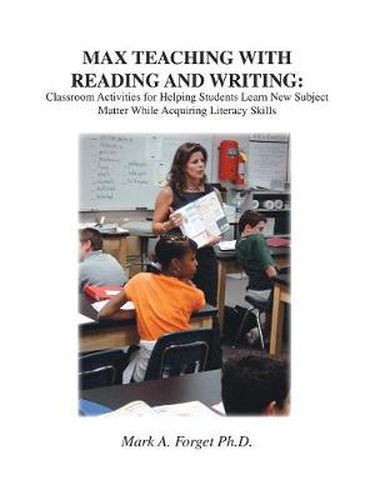
This book is divided into two parts.
Part I presents to the reader three essential components of a complete reading/writing-to-learn classroom. The three components are 1) a three-step lesson framework (MAX Teaching), 2) a three-step skill acquisition model (SAM), and 3) the systematic and formulaic use of cooperative learning (CL). The three of these components combine and are interwoven to provide for and to facilitate student acquisition of both content and skills through daily practice. Each of these will be described, explained, and justified with supporting research based on what we have learned during the 20th century from cognitive psychology, and through the more modern study of the human brain and brain functioning in the learning process.
Part II describes specific classroom strategies that have been developed over the last three decades. Each strategy is introduced, explained, and then presented as a generic lesson plan that could be applied to virtually any given subject area lesson. These lessons have been carefully laid out to include all three components listed above. Each lesson includes step-by-step instructions on what to do and say throughout the lesson to incorporate the use of the MAX teaching framework, a focus on skill development, and important elements of cooperative learning. My work with thousands of teachers over the past 11 years has led me to see the desire for such explicitly outlined lessons. The lessons are by no means the only way to apply a particular strategy. However, each is based on years of experience with students in various subject areas and of various ages. That being said, the way the lessons in part two are presented is meant to be generic enough and flexible enough to be helpful in assisting any teacher to become comfortable with the use of reading and writing to help students acquire both content and skills.
$9.00 standard shipping within Australia
FREE standard shipping within Australia for orders over $100.00
Express & International shipping calculated at checkout
Stock availability can be subject to change without notice. We recommend calling the shop or contacting our online team to check availability of low stock items. Please see our Shopping Online page for more details.
This title is printed to order. This book may have been self-published. If so, we cannot guarantee the quality of the content. In the main most books will have gone through the editing process however some may not. We therefore suggest that you be aware of this before ordering this book. If in doubt check either the author or publisher’s details as we are unable to accept any returns unless they are faulty. Please contact us if you have any questions.
This book is divided into two parts.
Part I presents to the reader three essential components of a complete reading/writing-to-learn classroom. The three components are 1) a three-step lesson framework (MAX Teaching), 2) a three-step skill acquisition model (SAM), and 3) the systematic and formulaic use of cooperative learning (CL). The three of these components combine and are interwoven to provide for and to facilitate student acquisition of both content and skills through daily practice. Each of these will be described, explained, and justified with supporting research based on what we have learned during the 20th century from cognitive psychology, and through the more modern study of the human brain and brain functioning in the learning process.
Part II describes specific classroom strategies that have been developed over the last three decades. Each strategy is introduced, explained, and then presented as a generic lesson plan that could be applied to virtually any given subject area lesson. These lessons have been carefully laid out to include all three components listed above. Each lesson includes step-by-step instructions on what to do and say throughout the lesson to incorporate the use of the MAX teaching framework, a focus on skill development, and important elements of cooperative learning. My work with thousands of teachers over the past 11 years has led me to see the desire for such explicitly outlined lessons. The lessons are by no means the only way to apply a particular strategy. However, each is based on years of experience with students in various subject areas and of various ages. That being said, the way the lessons in part two are presented is meant to be generic enough and flexible enough to be helpful in assisting any teacher to become comfortable with the use of reading and writing to help students acquire both content and skills.
Search our extensive online catalogue.
