Readings Newsletter
Become a Readings Member to make your shopping experience even easier.
Sign in or sign up for free!
You’re not far away from qualifying for FREE standard shipping within Australia
You’ve qualified for FREE standard shipping within Australia
The cart is loading…


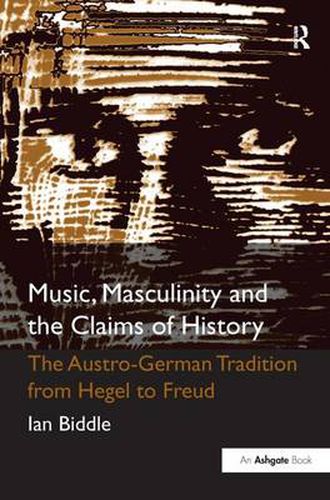
What does it mean to think of Western Art music - and the Austro-German contribution to that repertory - as a tradition? How are men and masculinities implicated in the shaping of that tradition? And how is the writing of the history (or histories) of that tradition shaped by men and masculinities? This book seeks to answer these and other questions by drawing both on a wide range of German-language writings on music, sound and listening from the so-called long nineteenth century (circa 1800-1918), and a range of critical-theoretical texts from the post-war continental philosophical and psychoanalytic traditions, including Lacan, Zizek, Serres, Derrida and Kittler. The book is focussed in particular on bringing the object of historical writing itself into scrutiny by engaging in what Zizek has called a ‘historicity’ or a way of writing about the past that not merely acknowledges the ahistorical kernel of historical writing, but brings that kernel into the light of day, takes account of it and puts it into play. The book is thus committed to a kind of historical writing that is open-ended - though not ideologically naA-ve - and that does not fix or stabilize the nature of the relationship between so-called ‘primary’ and ‘secondary’ texts. The book consists of an introduction, which places the study of classical music and the Austro-German tradition within broader debates about the value of that tradition, and four extensive case studies: an analysis of the cultural-historical category of listening around 1800; a close reading of A. B. Marx’s Beethoven monograph of 1859; a consideration of Heinrich Schenker’s attitudes to the mob and the vernacular more broadly and an examination, through Franz Kafka, of the figure of Mahler’s body.
$9.00 standard shipping within Australia
FREE standard shipping within Australia for orders over $100.00
Express & International shipping calculated at checkout
Stock availability can be subject to change without notice. We recommend calling the shop or contacting our online team to check availability of low stock items. Please see our Shopping Online page for more details.
What does it mean to think of Western Art music - and the Austro-German contribution to that repertory - as a tradition? How are men and masculinities implicated in the shaping of that tradition? And how is the writing of the history (or histories) of that tradition shaped by men and masculinities? This book seeks to answer these and other questions by drawing both on a wide range of German-language writings on music, sound and listening from the so-called long nineteenth century (circa 1800-1918), and a range of critical-theoretical texts from the post-war continental philosophical and psychoanalytic traditions, including Lacan, Zizek, Serres, Derrida and Kittler. The book is focussed in particular on bringing the object of historical writing itself into scrutiny by engaging in what Zizek has called a ‘historicity’ or a way of writing about the past that not merely acknowledges the ahistorical kernel of historical writing, but brings that kernel into the light of day, takes account of it and puts it into play. The book is thus committed to a kind of historical writing that is open-ended - though not ideologically naA-ve - and that does not fix or stabilize the nature of the relationship between so-called ‘primary’ and ‘secondary’ texts. The book consists of an introduction, which places the study of classical music and the Austro-German tradition within broader debates about the value of that tradition, and four extensive case studies: an analysis of the cultural-historical category of listening around 1800; a close reading of A. B. Marx’s Beethoven monograph of 1859; a consideration of Heinrich Schenker’s attitudes to the mob and the vernacular more broadly and an examination, through Franz Kafka, of the figure of Mahler’s body.
Search our extensive online catalogue.
