Readings Newsletter
Become a Readings Member to make your shopping experience even easier.
Sign in or sign up for free!
You’re not far away from qualifying for FREE standard shipping within Australia
You’ve qualified for FREE standard shipping within Australia
The cart is loading…


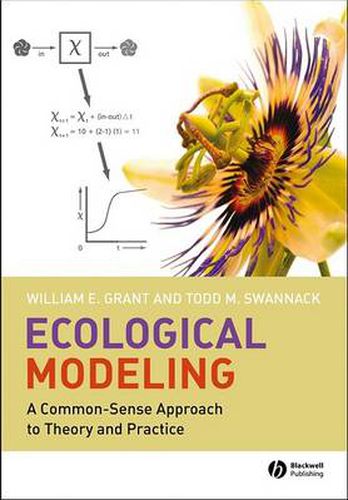
Ecological Modeling: A Commonsense Approach to Theory and Practice explores how simulation modeling and its new ecological applications can offer solutions to complex natural resource management problems. This is a practical guide for students, teachers, and professional ecologists. It examines four phases of the modeling process: conceptual model formulation, quantitative model specification, model evaluation, and model use. It provides useful building blocks for constructing systems simulation models. It includes a format for reporting the development and use of simulation models. It offers an integrated systems perspective for students, faculty, and professionals. It features helpful insights from the author, gained over 30 years of university teaching. ‘I can strongly recommend the book as textbook for all courses in population dynamic modeling particularly when the course is planned for the second or third year of a bachelor study in ecology, environmental science or ecological engineering. It uncovers very clearly for the readers the scientific idea and thinking behind modeling and all the necessary steps in the development of models’ - Ecological Modeling Journal, 2009 .
$9.00 standard shipping within Australia
FREE standard shipping within Australia for orders over $100.00
Express & International shipping calculated at checkout
Stock availability can be subject to change without notice. We recommend calling the shop or contacting our online team to check availability of low stock items. Please see our Shopping Online page for more details.
Ecological Modeling: A Commonsense Approach to Theory and Practice explores how simulation modeling and its new ecological applications can offer solutions to complex natural resource management problems. This is a practical guide for students, teachers, and professional ecologists. It examines four phases of the modeling process: conceptual model formulation, quantitative model specification, model evaluation, and model use. It provides useful building blocks for constructing systems simulation models. It includes a format for reporting the development and use of simulation models. It offers an integrated systems perspective for students, faculty, and professionals. It features helpful insights from the author, gained over 30 years of university teaching. ‘I can strongly recommend the book as textbook for all courses in population dynamic modeling particularly when the course is planned for the second or third year of a bachelor study in ecology, environmental science or ecological engineering. It uncovers very clearly for the readers the scientific idea and thinking behind modeling and all the necessary steps in the development of models’ - Ecological Modeling Journal, 2009 .
Search our extensive online catalogue.
