Readings Newsletter
Become a Readings Member to make your shopping experience even easier.
Sign in or sign up for free!
You’re not far away from qualifying for FREE standard shipping within Australia
You’ve qualified for FREE standard shipping within Australia
The cart is loading…


This title is printed to order. This book may have been self-published. If so, we cannot guarantee the quality of the content. In the main most books will have gone through the editing process however some may not. We therefore suggest that you be aware of this before ordering this book. If in doubt check either the author or publisher’s details as we are unable to accept any returns unless they are faulty. Please contact us if you have any questions.
Synthesizing the findings from a wide range of disciplines - from biology and anthropology to philosophy and linguistics - the emerging field of Biosemiotics explores the highly complex phenomenon of sign processing in living systems. Seeking to advance a naturalistic understanding of the evolution and development of sign-dependent life processes, contemporary biosemiotic theory offers important new conceptual tools for the scientific understanding of mind and meaning, for the development of artificial intelligence, and for the ongoing research into the rich diversity of non-verbal human, animal and biological communication processes.
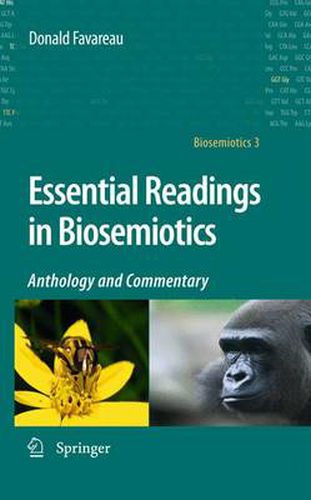
Donald Favareau’s Essential Readings in Biosemiotics has been designed as a single-source overview of the major works informing this new interdiscipline, and provides scholarly historical and analytical commentary on each of the texts presented. The first of its kind, this book constitutes a valuable resource to both bioscientists and to semioticians interested in this emerging new discipline, and can function as a primary textbook for students in biosemiotics, as well.
Moreover, because of its inherently interdisciplinary nature and its focus on the ‘big questions’ of cognition, meaning and evolutionary biology, this volume should be of interest to anyone working in the fields of cognitive science, theoretical biology, philosophy of mind, evolutionary psychology, communication studies or the history and philosophy of science.
$9.00 standard shipping within Australia
FREE standard shipping within Australia for orders over $100.00
Express & International shipping calculated at checkout
Stock availability can be subject to change without notice. We recommend calling the shop or contacting our online team to check availability of low stock items. Please see our Shopping Online page for more details.
This title is printed to order. This book may have been self-published. If so, we cannot guarantee the quality of the content. In the main most books will have gone through the editing process however some may not. We therefore suggest that you be aware of this before ordering this book. If in doubt check either the author or publisher’s details as we are unable to accept any returns unless they are faulty. Please contact us if you have any questions.
Synthesizing the findings from a wide range of disciplines - from biology and anthropology to philosophy and linguistics - the emerging field of Biosemiotics explores the highly complex phenomenon of sign processing in living systems. Seeking to advance a naturalistic understanding of the evolution and development of sign-dependent life processes, contemporary biosemiotic theory offers important new conceptual tools for the scientific understanding of mind and meaning, for the development of artificial intelligence, and for the ongoing research into the rich diversity of non-verbal human, animal and biological communication processes.
Donald Favareau’s Essential Readings in Biosemiotics has been designed as a single-source overview of the major works informing this new interdiscipline, and provides scholarly historical and analytical commentary on each of the texts presented. The first of its kind, this book constitutes a valuable resource to both bioscientists and to semioticians interested in this emerging new discipline, and can function as a primary textbook for students in biosemiotics, as well.
Moreover, because of its inherently interdisciplinary nature and its focus on the ‘big questions’ of cognition, meaning and evolutionary biology, this volume should be of interest to anyone working in the fields of cognitive science, theoretical biology, philosophy of mind, evolutionary psychology, communication studies or the history and philosophy of science.
Search our extensive online catalogue.
