Readings Newsletter
Become a Readings Member to make your shopping experience even easier.
Sign in or sign up for free!
You’re not far away from qualifying for FREE standard shipping within Australia
You’ve qualified for FREE standard shipping within Australia
The cart is loading…


This title is printed to order. This book may have been self-published. If so, we cannot guarantee the quality of the content. In the main most books will have gone through the editing process however some may not. We therefore suggest that you be aware of this before ordering this book. If in doubt check either the author or publisher’s details as we are unable to accept any returns unless they are faulty. Please contact us if you have any questions.
Global warming, shortage of low-cost oil resources and the increasing demand for energy are currently controlling the world’s economic expansion while often opposing desires for sustainable and peaceful development. In this context, atomic energy satisfactorily fulfills the criteria of low carbon gas production and high overall yield. However, in the absence of industrial fast-breeders the use of nuclear fuel is not optimal, and the production of high activity waste materials is at a maximum. These are the principal reasons for the development of a new, fourth generation of nuclear reactors, minimizing the undesirable side-effects of current nuclear energy production technology while increasing yields by increasing operation temperatures and opening the way for the industrial production of hydrogen through the decomposition of water.
The construction and use of such reactors is hindered by several factors, including performance limitations of known structural materials, particularly if the life of the projected systems had to extend over the periods necessary to achieve low costs (at least 60 years).
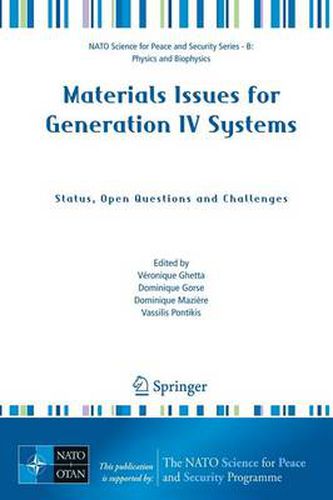
This book collects lectures and seminars presented at the homonymous NATO ASI held in autumn 2007 at the Institut d'Etudes Scientifiques in Cargese, France. The adopted approach aims at improving and coordinating basic knowledge in materials science and engineering with specific areas of condensed matter physics, the physics of particle/matter interaction and of radiation damage. It is our belief that this methodology is crucially conditioning the development and the industrial production of new structural materials capable of coping with the requirements of these future reactors.
$9.00 standard shipping within Australia
FREE standard shipping within Australia for orders over $100.00
Express & International shipping calculated at checkout
Stock availability can be subject to change without notice. We recommend calling the shop or contacting our online team to check availability of low stock items. Please see our Shopping Online page for more details.
This title is printed to order. This book may have been self-published. If so, we cannot guarantee the quality of the content. In the main most books will have gone through the editing process however some may not. We therefore suggest that you be aware of this before ordering this book. If in doubt check either the author or publisher’s details as we are unable to accept any returns unless they are faulty. Please contact us if you have any questions.
Global warming, shortage of low-cost oil resources and the increasing demand for energy are currently controlling the world’s economic expansion while often opposing desires for sustainable and peaceful development. In this context, atomic energy satisfactorily fulfills the criteria of low carbon gas production and high overall yield. However, in the absence of industrial fast-breeders the use of nuclear fuel is not optimal, and the production of high activity waste materials is at a maximum. These are the principal reasons for the development of a new, fourth generation of nuclear reactors, minimizing the undesirable side-effects of current nuclear energy production technology while increasing yields by increasing operation temperatures and opening the way for the industrial production of hydrogen through the decomposition of water.
The construction and use of such reactors is hindered by several factors, including performance limitations of known structural materials, particularly if the life of the projected systems had to extend over the periods necessary to achieve low costs (at least 60 years).
This book collects lectures and seminars presented at the homonymous NATO ASI held in autumn 2007 at the Institut d'Etudes Scientifiques in Cargese, France. The adopted approach aims at improving and coordinating basic knowledge in materials science and engineering with specific areas of condensed matter physics, the physics of particle/matter interaction and of radiation damage. It is our belief that this methodology is crucially conditioning the development and the industrial production of new structural materials capable of coping with the requirements of these future reactors.
Search our extensive online catalogue.
