Readings Newsletter
Become a Readings Member to make your shopping experience even easier.
Sign in or sign up for free!
You’re not far away from qualifying for FREE standard shipping within Australia
You’ve qualified for FREE standard shipping within Australia
The cart is loading…


This title is printed to order. This book may have been self-published. If so, we cannot guarantee the quality of the content. In the main most books will have gone through the editing process however some may not. We therefore suggest that you be aware of this before ordering this book. If in doubt check either the author or publisher’s details as we are unable to accept any returns unless they are faulty. Please contact us if you have any questions.
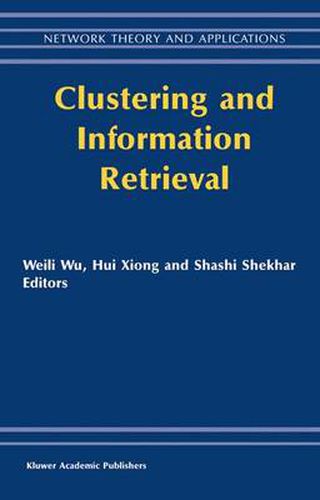
Clustering is an important technique for discovering relatively dense sub-regions or sub-spaces of a multi-dimension data distribution. Clus tering has been used in information retrieval for many different purposes, such as query expansion, document grouping, document indexing, and visualization of search results. In this book, we address issues of cluster ing algorithms, evaluation methodologies, applications, and architectures for information retrieval. The first two chapters discuss clustering algorithms. The chapter from Baeza-Yates et al. describes a clustering method for a general metric space which is a common model of data relevant to information retrieval. The chapter by Guha, Rastogi, and Shim presents a survey as well as detailed discussion of two clustering algorithms: CURE and ROCK for numeric data and categorical data respectively. Evaluation methodologies are addressed in the next two chapters. Ertoz et al. demonstrate the use of text retrieval benchmarks, such as TRECS, to evaluate clustering algorithms. He et al. provide objective measures of clustering quality in their chapter. Applications of clustering methods to information retrieval is ad dressed in the next four chapters. Chu et al. and Noel et al. explore feature selection using word stems, phrases, and link associations for document clustering and indexing. Wen et al. and Sung et al. discuss applications of clustering to user queries and data cleansing. Finally, we consider the problem of designing architectures for infor mation retrieval. Crichton, Hughes, and Kelly elaborate on the devel opment of a scientific data system architecture for information retrieval.
$9.00 standard shipping within Australia
FREE standard shipping within Australia for orders over $100.00
Express & International shipping calculated at checkout
Stock availability can be subject to change without notice. We recommend calling the shop or contacting our online team to check availability of low stock items. Please see our Shopping Online page for more details.
This title is printed to order. This book may have been self-published. If so, we cannot guarantee the quality of the content. In the main most books will have gone through the editing process however some may not. We therefore suggest that you be aware of this before ordering this book. If in doubt check either the author or publisher’s details as we are unable to accept any returns unless they are faulty. Please contact us if you have any questions.
Clustering is an important technique for discovering relatively dense sub-regions or sub-spaces of a multi-dimension data distribution. Clus tering has been used in information retrieval for many different purposes, such as query expansion, document grouping, document indexing, and visualization of search results. In this book, we address issues of cluster ing algorithms, evaluation methodologies, applications, and architectures for information retrieval. The first two chapters discuss clustering algorithms. The chapter from Baeza-Yates et al. describes a clustering method for a general metric space which is a common model of data relevant to information retrieval. The chapter by Guha, Rastogi, and Shim presents a survey as well as detailed discussion of two clustering algorithms: CURE and ROCK for numeric data and categorical data respectively. Evaluation methodologies are addressed in the next two chapters. Ertoz et al. demonstrate the use of text retrieval benchmarks, such as TRECS, to evaluate clustering algorithms. He et al. provide objective measures of clustering quality in their chapter. Applications of clustering methods to information retrieval is ad dressed in the next four chapters. Chu et al. and Noel et al. explore feature selection using word stems, phrases, and link associations for document clustering and indexing. Wen et al. and Sung et al. discuss applications of clustering to user queries and data cleansing. Finally, we consider the problem of designing architectures for infor mation retrieval. Crichton, Hughes, and Kelly elaborate on the devel opment of a scientific data system architecture for information retrieval.
Search our extensive online catalogue.
