Readings Newsletter
Become a Readings Member to make your shopping experience even easier.
Sign in or sign up for free!
You’re not far away from qualifying for FREE standard shipping within Australia
You’ve qualified for FREE standard shipping within Australia
The cart is loading…


This title is printed to order. This book may have been self-published. If so, we cannot guarantee the quality of the content. In the main most books will have gone through the editing process however some may not. We therefore suggest that you be aware of this before ordering this book. If in doubt check either the author or publisher’s details as we are unable to accept any returns unless they are faulty. Please contact us if you have any questions.
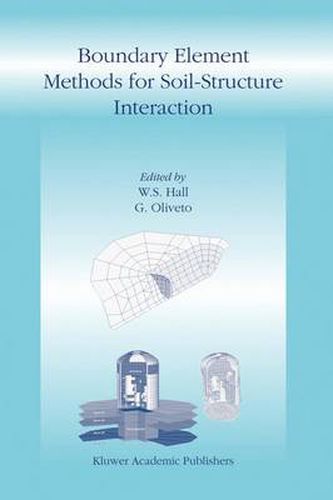
This text consists of up-to-date contributions from leading European researchers and practitioners centred on soil-structure interaction problems. The boundary element method is used as an appropriate solution technique for problems involving complex geometries, and often unbounded media. For non-linear problems the boundary element method is used in conjunction with the finite element method. Other topics are treated, such as fracture mechanics, from which advanced methods may be taken for future use in earthquake engineering. Overall, the book provides an authorative guide to the literature on the subject covered and should prove a useful tool for practising engineers, students and scholars in the fields of structural, geotechnical and earthquake engineering. Engineers and students may readily locate the materials or methods available for the solution of their particular problem while scholars may discover methods previously not considered for the particular application being considered. The book should also be of interest to the larger community of applied mathematicians and software developers in seeing a field where the boundary element method can provide a wealth of relevant and efficient solutions. Finally the book can be used as a starting point for research and for the investigation of unsolved problems in soil-structure and fluids-structure-soil interaction, particularly non-linear coupled problems which could be advantageously approached by means of boundary element methods.
$9.00 standard shipping within Australia
FREE standard shipping within Australia for orders over $100.00
Express & International shipping calculated at checkout
Stock availability can be subject to change without notice. We recommend calling the shop or contacting our online team to check availability of low stock items. Please see our Shopping Online page for more details.
This title is printed to order. This book may have been self-published. If so, we cannot guarantee the quality of the content. In the main most books will have gone through the editing process however some may not. We therefore suggest that you be aware of this before ordering this book. If in doubt check either the author or publisher’s details as we are unable to accept any returns unless they are faulty. Please contact us if you have any questions.
This text consists of up-to-date contributions from leading European researchers and practitioners centred on soil-structure interaction problems. The boundary element method is used as an appropriate solution technique for problems involving complex geometries, and often unbounded media. For non-linear problems the boundary element method is used in conjunction with the finite element method. Other topics are treated, such as fracture mechanics, from which advanced methods may be taken for future use in earthquake engineering. Overall, the book provides an authorative guide to the literature on the subject covered and should prove a useful tool for practising engineers, students and scholars in the fields of structural, geotechnical and earthquake engineering. Engineers and students may readily locate the materials or methods available for the solution of their particular problem while scholars may discover methods previously not considered for the particular application being considered. The book should also be of interest to the larger community of applied mathematicians and software developers in seeing a field where the boundary element method can provide a wealth of relevant and efficient solutions. Finally the book can be used as a starting point for research and for the investigation of unsolved problems in soil-structure and fluids-structure-soil interaction, particularly non-linear coupled problems which could be advantageously approached by means of boundary element methods.
Search our extensive online catalogue.
