Readings Newsletter
Become a Readings Member to make your shopping experience even easier.
Sign in or sign up for free!
You’re not far away from qualifying for FREE standard shipping within Australia
You’ve qualified for FREE standard shipping within Australia
The cart is loading…


This title is printed to order. This book may have been self-published. If so, we cannot guarantee the quality of the content. In the main most books will have gone through the editing process however some may not. We therefore suggest that you be aware of this before ordering this book. If in doubt check either the author or publisher’s details as we are unable to accept any returns unless they are faulty. Please contact us if you have any questions.
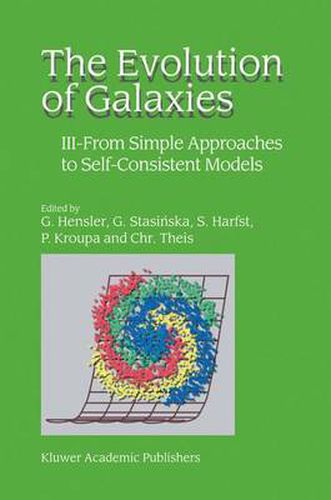
Galaxies have a history. This has become clear from sky surveys, which have shown that distant galaxies, formed early in the life of the Universe, differ from the nearby ones. Observational windows at ultraviolet, infrared and millimetric wavelengths (provided by ROSAT, IRAM, IUE, IRAS, ISO) have revealed that galaxies contain a wealth of components: very hot gas, atomic hydrogen, molecules, dust, dark matterificant advance is expected from the results of new instruments (VLT, FIRST, XMM) which will allow one to explore the most distant Universe. Three Euroconferences punctuated this new epoch in galactic research, bringing together specialists in various fields of Astronomy. The first one, held in Granada (Spain) in May 2000, addressed the observational clues. The second one took place in October 2001 in St. Denis de la Reunion (France) and reviewed the basic building blocks and small-scale processes in galaxy evolution. The third conference was held in Kiel (Germany) in July 2002 and addressed the appropriate modelling of galaxy evolution from their cosmological formation to their presently observable structures. This book contains the proceedings of the third conference and presents the actual state-of-the-art of modelling galaxy evolution.
$9.00 standard shipping within Australia
FREE standard shipping within Australia for orders over $100.00
Express & International shipping calculated at checkout
Stock availability can be subject to change without notice. We recommend calling the shop or contacting our online team to check availability of low stock items. Please see our Shopping Online page for more details.
This title is printed to order. This book may have been self-published. If so, we cannot guarantee the quality of the content. In the main most books will have gone through the editing process however some may not. We therefore suggest that you be aware of this before ordering this book. If in doubt check either the author or publisher’s details as we are unable to accept any returns unless they are faulty. Please contact us if you have any questions.
Galaxies have a history. This has become clear from sky surveys, which have shown that distant galaxies, formed early in the life of the Universe, differ from the nearby ones. Observational windows at ultraviolet, infrared and millimetric wavelengths (provided by ROSAT, IRAM, IUE, IRAS, ISO) have revealed that galaxies contain a wealth of components: very hot gas, atomic hydrogen, molecules, dust, dark matterificant advance is expected from the results of new instruments (VLT, FIRST, XMM) which will allow one to explore the most distant Universe. Three Euroconferences punctuated this new epoch in galactic research, bringing together specialists in various fields of Astronomy. The first one, held in Granada (Spain) in May 2000, addressed the observational clues. The second one took place in October 2001 in St. Denis de la Reunion (France) and reviewed the basic building blocks and small-scale processes in galaxy evolution. The third conference was held in Kiel (Germany) in July 2002 and addressed the appropriate modelling of galaxy evolution from their cosmological formation to their presently observable structures. This book contains the proceedings of the third conference and presents the actual state-of-the-art of modelling galaxy evolution.
Search our extensive online catalogue.
