Readings Newsletter
Become a Readings Member to make your shopping experience even easier.
Sign in or sign up for free!
You’re not far away from qualifying for FREE standard shipping within Australia
You’ve qualified for FREE standard shipping within Australia
The cart is loading…


This title is printed to order. This book may have been self-published. If so, we cannot guarantee the quality of the content. In the main most books will have gone through the editing process however some may not. We therefore suggest that you be aware of this before ordering this book. If in doubt check either the author or publisher’s details as we are unable to accept any returns unless they are faulty. Please contact us if you have any questions.
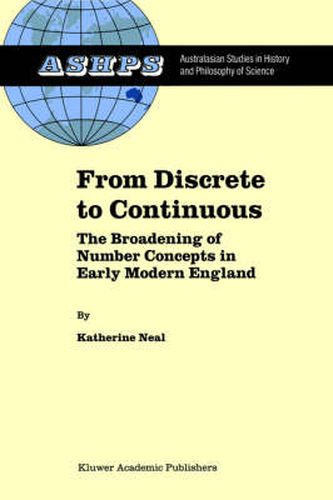
In the early modern period, a crucial transformation occurred in the classical conception of number and magnitude. Traditionally, numbers were merely collections of discrete units that measured some multiple. Magnitude, on the other hand, was usually described as being continuous, or being divisible into parts that are infinitely divisible. This traditional idea of discrete number versus continuous magnitude was challenged in the early modern period in several ways. This detailed study explores how the development of algebraic symbolism, logarithms and the growing practical demands for an expanded number concept all contributed to a broadening of the number concept in early modern England. An interest in solving practical problems was not, in itself, enough to cause a generalisation of the number concept. It was the combined impact of novel practical applications together with the concomitant development of such mathematical advances as algebraic notation and logarithms that produced a broadened number concept.
$9.00 standard shipping within Australia
FREE standard shipping within Australia for orders over $100.00
Express & International shipping calculated at checkout
Stock availability can be subject to change without notice. We recommend calling the shop or contacting our online team to check availability of low stock items. Please see our Shopping Online page for more details.
This title is printed to order. This book may have been self-published. If so, we cannot guarantee the quality of the content. In the main most books will have gone through the editing process however some may not. We therefore suggest that you be aware of this before ordering this book. If in doubt check either the author or publisher’s details as we are unable to accept any returns unless they are faulty. Please contact us if you have any questions.
In the early modern period, a crucial transformation occurred in the classical conception of number and magnitude. Traditionally, numbers were merely collections of discrete units that measured some multiple. Magnitude, on the other hand, was usually described as being continuous, or being divisible into parts that are infinitely divisible. This traditional idea of discrete number versus continuous magnitude was challenged in the early modern period in several ways. This detailed study explores how the development of algebraic symbolism, logarithms and the growing practical demands for an expanded number concept all contributed to a broadening of the number concept in early modern England. An interest in solving practical problems was not, in itself, enough to cause a generalisation of the number concept. It was the combined impact of novel practical applications together with the concomitant development of such mathematical advances as algebraic notation and logarithms that produced a broadened number concept.
Search our extensive online catalogue.
