Readings Newsletter
Become a Readings Member to make your shopping experience even easier.
Sign in or sign up for free!
You’re not far away from qualifying for FREE standard shipping within Australia
You’ve qualified for FREE standard shipping within Australia
The cart is loading…


A comprehensive, up-to-date discussion of what enzymes are, how they work, and how they catalyse enzymatic reactions
Enzymes are giant macromolecules which catalyse all the biochemical reactions in living cells. Their three-dimensional structures are highly complex, yet they are formed by spontaneous folding of a linear polypeptide chain. Their catalytic properties are even more impressive than synthetic catalysts which operate under more extreme conditions. Enzyme-catalysed reactions proceed very high enantioselectivity and enantiospecificity at rates which approach "catalytic perfection." Living cells carry out a huge repertoire of enzyme-catalysed chemical reactions, some of which have little or no precedent in organic chemistry.
New case studies A new section on oxygen activation by enzymes Expanded sections on membrane proteins, enzyme purification, enzymatic phosphoryl transfer reactions, fatty acid biosynthesis and polyketide biosynthesis Additional examples from recent literature used to illustrate key points Additional problems and solutions outlined and updated Further Reading sections at the end of each chapter Over 40 full-colour figures of the active sites of enzymes that illustrate the interplay between enzyme structure and function
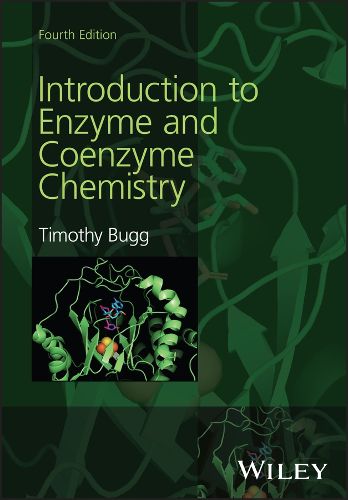
Introduction to Enzyme and Coenzyme Chemistry provides a concise but comprehensive account from the perspective of organic chemistry that explains what enzymes are, how they work, and how they catalyse many of the major classes of enzymatic reactions. It will prove invaluable to undergraduate and postgraduate students of organic, bio-organic and medicinal chemistry, chemical biology, biochemistry and biotechnology.
$9.00 standard shipping within Australia
FREE standard shipping within Australia for orders over $100.00
Express & International shipping calculated at checkout
Stock availability can be subject to change without notice. We recommend calling the shop or contacting our online team to check availability of low stock items. Please see our Shopping Online page for more details.
A comprehensive, up-to-date discussion of what enzymes are, how they work, and how they catalyse enzymatic reactions
Enzymes are giant macromolecules which catalyse all the biochemical reactions in living cells. Their three-dimensional structures are highly complex, yet they are formed by spontaneous folding of a linear polypeptide chain. Their catalytic properties are even more impressive than synthetic catalysts which operate under more extreme conditions. Enzyme-catalysed reactions proceed very high enantioselectivity and enantiospecificity at rates which approach "catalytic perfection." Living cells carry out a huge repertoire of enzyme-catalysed chemical reactions, some of which have little or no precedent in organic chemistry.
New case studies A new section on oxygen activation by enzymes Expanded sections on membrane proteins, enzyme purification, enzymatic phosphoryl transfer reactions, fatty acid biosynthesis and polyketide biosynthesis Additional examples from recent literature used to illustrate key points Additional problems and solutions outlined and updated Further Reading sections at the end of each chapter Over 40 full-colour figures of the active sites of enzymes that illustrate the interplay between enzyme structure and function
Introduction to Enzyme and Coenzyme Chemistry provides a concise but comprehensive account from the perspective of organic chemistry that explains what enzymes are, how they work, and how they catalyse many of the major classes of enzymatic reactions. It will prove invaluable to undergraduate and postgraduate students of organic, bio-organic and medicinal chemistry, chemical biology, biochemistry and biotechnology.
Search our extensive online catalogue.
