Readings Newsletter
Become a Readings Member to make your shopping experience even easier.
Sign in or sign up for free!
You’re not far away from qualifying for FREE standard shipping within Australia
You’ve qualified for FREE standard shipping within Australia
The cart is loading…


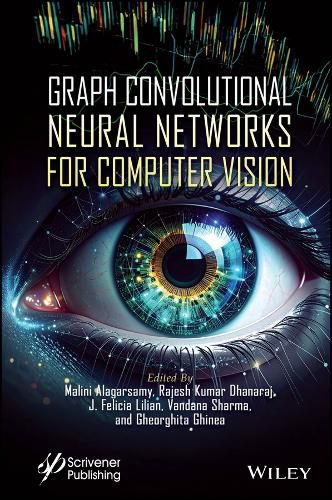
Revolutionize your machine learning practice with this essential book that provides expert insights into leveraging Graph Convolutional Networks (GCNNs) to overcome the limitations of traditional CNNs.
In the last decade, computer vision has become a major focus for addressing the world's growing processing needs. Many existing deep learning architectures for computer vision challenges are based on convolutional neural networks (CNNs). Despite their great achievements, CNNs struggle to encode the intrinsic graph patterns in specific learning tasks. In contrast, graph convolutional networks have been used to address several computer vision issues with equivalent or superior results. The use of GCNNs has shown significant achievement in image classifications, video understanding, point clouds, meshes, and other applications in natural language processing. This book focuses on the applications of graph convolutional networks in computer vision. Through expert insights, it explores how researchers are finding ways to perform convolution algorithms on graphs to improve the way we use machine learning.
$9.00 standard shipping within Australia
FREE standard shipping within Australia for orders over $100.00
Express & International shipping calculated at checkout
Stock availability can be subject to change without notice. We recommend calling the shop or contacting our online team to check availability of low stock items. Please see our Shopping Online page for more details.
Revolutionize your machine learning practice with this essential book that provides expert insights into leveraging Graph Convolutional Networks (GCNNs) to overcome the limitations of traditional CNNs.
In the last decade, computer vision has become a major focus for addressing the world's growing processing needs. Many existing deep learning architectures for computer vision challenges are based on convolutional neural networks (CNNs). Despite their great achievements, CNNs struggle to encode the intrinsic graph patterns in specific learning tasks. In contrast, graph convolutional networks have been used to address several computer vision issues with equivalent or superior results. The use of GCNNs has shown significant achievement in image classifications, video understanding, point clouds, meshes, and other applications in natural language processing. This book focuses on the applications of graph convolutional networks in computer vision. Through expert insights, it explores how researchers are finding ways to perform convolution algorithms on graphs to improve the way we use machine learning.
Search our extensive online catalogue.
