Readings Newsletter
Become a Readings Member to make your shopping experience even easier.
Sign in or sign up for free!
You’re not far away from qualifying for FREE standard shipping within Australia
You’ve qualified for FREE standard shipping within Australia
The cart is loading…


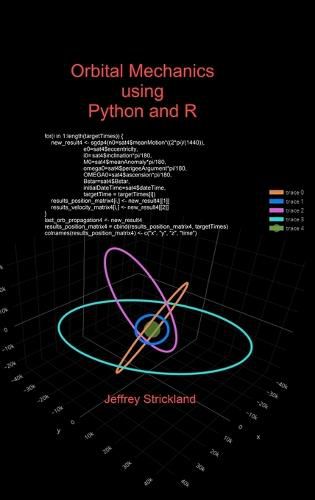
This book describes the mechanics or physics of resident space objects (RSOs) in orbits due to the gravitational force of the central mass, like the Earth. In other words, it's about the obit of satellites and other RSOs. Part 1 applies the laws of Newton and Kepler, considers 2-body and N-body problems, and explores Jacobi's constant and Lagrangian points. Using calculus, geometry, trigonometry, and algebra, it develops the equations of orbits and motion, transforms reference frames to other frames, like Cartesian to True Equator, Mean Equinox (TEME). The book investigates orbital maneuvers with applications like Hohmann transfers, and interplanetary trajectories hyperbolic departures. We develop the orbital parameters, like the semilatus rectum, mean anomaly, eccentricity, inclination, and argument of periapsis. Part 2 explores and implements the NORAD two-line element (TLE) set and uses the content to propagate state vectors( position and velocity) to plot orbits and ground tracks. We employ the SGD4 (LEO) propagator and SPD4 (deep space) propagator to validate orbits against Revisiting Spacetrack Report #3. We then use the results to project orbits forward in time and to simulate from selected orbital elements.
$9.00 standard shipping within Australia
FREE standard shipping within Australia for orders over $100.00
Express & International shipping calculated at checkout
Stock availability can be subject to change without notice. We recommend calling the shop or contacting our online team to check availability of low stock items. Please see our Shopping Online page for more details.
This book describes the mechanics or physics of resident space objects (RSOs) in orbits due to the gravitational force of the central mass, like the Earth. In other words, it's about the obit of satellites and other RSOs. Part 1 applies the laws of Newton and Kepler, considers 2-body and N-body problems, and explores Jacobi's constant and Lagrangian points. Using calculus, geometry, trigonometry, and algebra, it develops the equations of orbits and motion, transforms reference frames to other frames, like Cartesian to True Equator, Mean Equinox (TEME). The book investigates orbital maneuvers with applications like Hohmann transfers, and interplanetary trajectories hyperbolic departures. We develop the orbital parameters, like the semilatus rectum, mean anomaly, eccentricity, inclination, and argument of periapsis. Part 2 explores and implements the NORAD two-line element (TLE) set and uses the content to propagate state vectors( position and velocity) to plot orbits and ground tracks. We employ the SGD4 (LEO) propagator and SPD4 (deep space) propagator to validate orbits against Revisiting Spacetrack Report #3. We then use the results to project orbits forward in time and to simulate from selected orbital elements.
Search our extensive online catalogue.
