Readings Newsletter
Become a Readings Member to make your shopping experience even easier.
Sign in or sign up for free!
You’re not far away from qualifying for FREE standard shipping within Australia
You’ve qualified for FREE standard shipping within Australia
The cart is loading…


This title is printed to order. This book may have been self-published. If so, we cannot guarantee the quality of the content. In the main most books will have gone through the editing process however some may not. We therefore suggest that you be aware of this before ordering this book. If in doubt check either the author or publisher’s details as we are unable to accept any returns unless they are faulty. Please contact us if you have any questions.
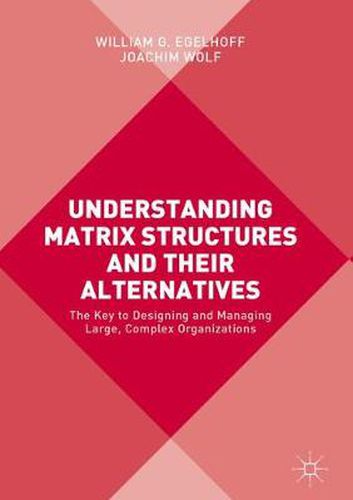
This book describes the use of matrix structures in large, complex organizations such as MNCs. Using an information-processing perspective of organization design, it develops a more comprehensive theory for fitting the structural configurations of matrix structures to key characteristics of firm strategy. Empirical research by the authors supports this theoretical framework. In addition to structural configuration, Understanding Matrix Structures identifies and develops the mode of decision making within a matrix as an important second dimension of matrix structure design. It can be either balanced (joint) decision making by the two dimensions of a matrix or rule-based decision making, where rules pre-assign certain decisions to one dimension or the other for unitary decision making. Recent exploratory research by the authors supports this conceptual framework and provides the potential to create a more flexible matrix structure- one that facilitates a more ambidextrous organization.
$9.00 standard shipping within Australia
FREE standard shipping within Australia for orders over $100.00
Express & International shipping calculated at checkout
Stock availability can be subject to change without notice. We recommend calling the shop or contacting our online team to check availability of low stock items. Please see our Shopping Online page for more details.
This title is printed to order. This book may have been self-published. If so, we cannot guarantee the quality of the content. In the main most books will have gone through the editing process however some may not. We therefore suggest that you be aware of this before ordering this book. If in doubt check either the author or publisher’s details as we are unable to accept any returns unless they are faulty. Please contact us if you have any questions.
This book describes the use of matrix structures in large, complex organizations such as MNCs. Using an information-processing perspective of organization design, it develops a more comprehensive theory for fitting the structural configurations of matrix structures to key characteristics of firm strategy. Empirical research by the authors supports this theoretical framework. In addition to structural configuration, Understanding Matrix Structures identifies and develops the mode of decision making within a matrix as an important second dimension of matrix structure design. It can be either balanced (joint) decision making by the two dimensions of a matrix or rule-based decision making, where rules pre-assign certain decisions to one dimension or the other for unitary decision making. Recent exploratory research by the authors supports this conceptual framework and provides the potential to create a more flexible matrix structure- one that facilitates a more ambidextrous organization.
Search our extensive online catalogue.
