Readings Newsletter
Become a Readings Member to make your shopping experience even easier.
Sign in or sign up for free!
You’re not far away from qualifying for FREE standard shipping within Australia
You’ve qualified for FREE standard shipping within Australia
The cart is loading…


This title is printed to order. This book may have been self-published. If so, we cannot guarantee the quality of the content. In the main most books will have gone through the editing process however some may not. We therefore suggest that you be aware of this before ordering this book. If in doubt check either the author or publisher’s details as we are unable to accept any returns unless they are faulty. Please contact us if you have any questions.
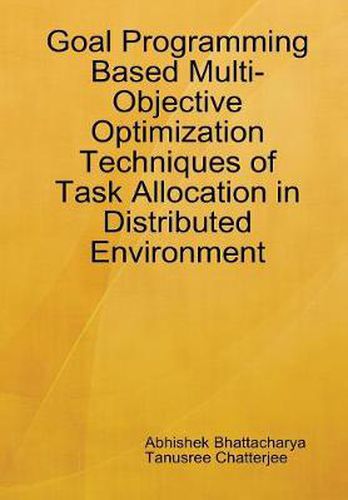
In a distributed computing system (DCS), we need to allocate a number of tasks to different processors for execution. The problem of task assignment in heterogeneous computing systems has been studied for many years with many variations and to accomplish various objectives, such as throughput maximization, reliability maximization, and cost minimization. There are also exists a set of system constraints related to memory and communication link capacity. Most of the existing approaches for task allocation deal with a single objective only. In this project we construct the task allocation problem as a multi-objective optimization problem to consider system constraints. The goal programming technique is used with pre-emptive priority structure to find the optimal allocation that not only optimize system reliability but also optimize memory as well as path load. The genetic algorithm is used to find the optimal allocations. Genetic algorithm is used to find the optimal allocations.
$9.00 standard shipping within Australia
FREE standard shipping within Australia for orders over $100.00
Express & International shipping calculated at checkout
Stock availability can be subject to change without notice. We recommend calling the shop or contacting our online team to check availability of low stock items. Please see our Shopping Online page for more details.
This title is printed to order. This book may have been self-published. If so, we cannot guarantee the quality of the content. In the main most books will have gone through the editing process however some may not. We therefore suggest that you be aware of this before ordering this book. If in doubt check either the author or publisher’s details as we are unable to accept any returns unless they are faulty. Please contact us if you have any questions.
In a distributed computing system (DCS), we need to allocate a number of tasks to different processors for execution. The problem of task assignment in heterogeneous computing systems has been studied for many years with many variations and to accomplish various objectives, such as throughput maximization, reliability maximization, and cost minimization. There are also exists a set of system constraints related to memory and communication link capacity. Most of the existing approaches for task allocation deal with a single objective only. In this project we construct the task allocation problem as a multi-objective optimization problem to consider system constraints. The goal programming technique is used with pre-emptive priority structure to find the optimal allocation that not only optimize system reliability but also optimize memory as well as path load. The genetic algorithm is used to find the optimal allocations. Genetic algorithm is used to find the optimal allocations.
Search our extensive online catalogue.
