Readings Newsletter
Become a Readings Member to make your shopping experience even easier.
Sign in or sign up for free!
You’re not far away from qualifying for FREE standard shipping within Australia
You’ve qualified for FREE standard shipping within Australia
The cart is loading…


This title is printed to order. This book may have been self-published. If so, we cannot guarantee the quality of the content. In the main most books will have gone through the editing process however some may not. We therefore suggest that you be aware of this before ordering this book. If in doubt check either the author or publisher’s details as we are unable to accept any returns unless they are faulty. Please contact us if you have any questions.
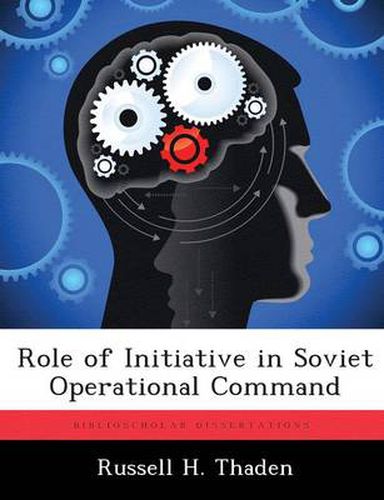
This monograph examines the role of initiative in Soviet operational level command. It seeks to answer the question: Do Soviet operational commanders have the personal initiative and latitude to react to unexpected or changed situations on their own responsibility? This question is prompted by a real perception that Soviet commanders tend to be rigid and inflexible due to over centralized command and control. If this perception is correct, the Soviet Army may be unable to react rapidly to changing situations. If it is false, Western military doctrine and planning may be based on false assumptions. This paper begins by defining the terms of the discussion. It defines the concept of personal initiative as it relates to military command. The paper points out that there is a common view that the Soviet concept is more restrictive than the U.S. concept, but concludes that there is really much in common. The paper also defines doctrine as it is used in the discussion. The paper then examines Soviet operational initiative through World War II. This begins with a brief discussion of the pre-war doctrinal basis. Then, three operational level commanders are examined. The first commander, General M. M. Popov did not display significant individual initiative during his February 1943 operations. The next commander discussed, General Pavel Rotmistrov, commanded a tank army during and after the Battle of Kursk in mid-1943. Rotmistrov showed considerable initiative and moral courage. He provides an important example of the increasing ability of the Soviet Army to tolerate initiative. The final commander examined is Marshal Koniev who showed extremely strong initiative and courage in developing his plan of operations for the Lvov-Sandomierz operation in July to August 1944. This section concludes with a discussion of the changes in Soviet doctrine during World War II that strengthened the importance of initiative. Next the monograph discusses the changes that have impacted on the i
$9.00 standard shipping within Australia
FREE standard shipping within Australia for orders over $100.00
Express & International shipping calculated at checkout
Stock availability can be subject to change without notice. We recommend calling the shop or contacting our online team to check availability of low stock items. Please see our Shopping Online page for more details.
This title is printed to order. This book may have been self-published. If so, we cannot guarantee the quality of the content. In the main most books will have gone through the editing process however some may not. We therefore suggest that you be aware of this before ordering this book. If in doubt check either the author or publisher’s details as we are unable to accept any returns unless they are faulty. Please contact us if you have any questions.
This monograph examines the role of initiative in Soviet operational level command. It seeks to answer the question: Do Soviet operational commanders have the personal initiative and latitude to react to unexpected or changed situations on their own responsibility? This question is prompted by a real perception that Soviet commanders tend to be rigid and inflexible due to over centralized command and control. If this perception is correct, the Soviet Army may be unable to react rapidly to changing situations. If it is false, Western military doctrine and planning may be based on false assumptions. This paper begins by defining the terms of the discussion. It defines the concept of personal initiative as it relates to military command. The paper points out that there is a common view that the Soviet concept is more restrictive than the U.S. concept, but concludes that there is really much in common. The paper also defines doctrine as it is used in the discussion. The paper then examines Soviet operational initiative through World War II. This begins with a brief discussion of the pre-war doctrinal basis. Then, three operational level commanders are examined. The first commander, General M. M. Popov did not display significant individual initiative during his February 1943 operations. The next commander discussed, General Pavel Rotmistrov, commanded a tank army during and after the Battle of Kursk in mid-1943. Rotmistrov showed considerable initiative and moral courage. He provides an important example of the increasing ability of the Soviet Army to tolerate initiative. The final commander examined is Marshal Koniev who showed extremely strong initiative and courage in developing his plan of operations for the Lvov-Sandomierz operation in July to August 1944. This section concludes with a discussion of the changes in Soviet doctrine during World War II that strengthened the importance of initiative. Next the monograph discusses the changes that have impacted on the i
Search our extensive online catalogue.
