Readings Newsletter
Become a Readings Member to make your shopping experience even easier.
Sign in or sign up for free!
You’re not far away from qualifying for FREE standard shipping within Australia
You’ve qualified for FREE standard shipping within Australia
The cart is loading…


This title is printed to order. This book may have been self-published. If so, we cannot guarantee the quality of the content. In the main most books will have gone through the editing process however some may not. We therefore suggest that you be aware of this before ordering this book. If in doubt check either the author or publisher’s details as we are unable to accept any returns unless they are faulty. Please contact us if you have any questions.
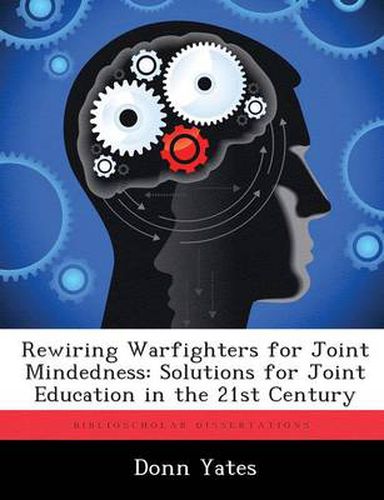
Despite the efforts of the Goldwaters Nichols Act of 1986, jointness continues to be a problem in the Department of Defense. Scholars point to both organizational and cultural problems as the root of the problem, but these explanations are incomplete. People comprise organization and people use culture as means of to explain identity, norms, and behavior. The individual level of analysis emerges as another explanation to the problem of jointness in order to complement the other two. In order to do this, the author uses the P2C framework as a means to develop joint-mindedness through the development of cognitive symmetry between officers from different services. P2C represents three elements: perspective, perception, and context. Cognitive symmetry occurs during the alignment of these three elements between individuals. Mistaken perspective, misperception, and faulty context create conditions for cognitive asymmetry which leads to problems with jointness. The current DOD Joint Qualification System (JQS) does not facilitate joint-mindedness. This system uses points and qualification levels to accredit prospective officers as joint qualified officers (JQO) but makes no provision to make them joint-minded. Additionally, the system gives the impression that joint qualification is a means for promotion to higher rank and not a method to inculcate jointness among the service branches. The author uses four Joint Environment Opportunities (JEO) for analysis of the current JQS: education, operations, staffwork, and training. The author evaluates each JEO against five criteria. The criteria are opportunity, frequency, perspective, perception, and context. From this analysis, education emerges as the best venue to develop joint-mindedness within the DOD. To facilitate this new approach, the author proposes three recommendations for joint education.
$9.00 standard shipping within Australia
FREE standard shipping within Australia for orders over $100.00
Express & International shipping calculated at checkout
Stock availability can be subject to change without notice. We recommend calling the shop or contacting our online team to check availability of low stock items. Please see our Shopping Online page for more details.
This title is printed to order. This book may have been self-published. If so, we cannot guarantee the quality of the content. In the main most books will have gone through the editing process however some may not. We therefore suggest that you be aware of this before ordering this book. If in doubt check either the author or publisher’s details as we are unable to accept any returns unless they are faulty. Please contact us if you have any questions.
Despite the efforts of the Goldwaters Nichols Act of 1986, jointness continues to be a problem in the Department of Defense. Scholars point to both organizational and cultural problems as the root of the problem, but these explanations are incomplete. People comprise organization and people use culture as means of to explain identity, norms, and behavior. The individual level of analysis emerges as another explanation to the problem of jointness in order to complement the other two. In order to do this, the author uses the P2C framework as a means to develop joint-mindedness through the development of cognitive symmetry between officers from different services. P2C represents three elements: perspective, perception, and context. Cognitive symmetry occurs during the alignment of these three elements between individuals. Mistaken perspective, misperception, and faulty context create conditions for cognitive asymmetry which leads to problems with jointness. The current DOD Joint Qualification System (JQS) does not facilitate joint-mindedness. This system uses points and qualification levels to accredit prospective officers as joint qualified officers (JQO) but makes no provision to make them joint-minded. Additionally, the system gives the impression that joint qualification is a means for promotion to higher rank and not a method to inculcate jointness among the service branches. The author uses four Joint Environment Opportunities (JEO) for analysis of the current JQS: education, operations, staffwork, and training. The author evaluates each JEO against five criteria. The criteria are opportunity, frequency, perspective, perception, and context. From this analysis, education emerges as the best venue to develop joint-mindedness within the DOD. To facilitate this new approach, the author proposes three recommendations for joint education.
Search our extensive online catalogue.
