Readings Newsletter
Become a Readings Member to make your shopping experience even easier.
Sign in or sign up for free!
You’re not far away from qualifying for FREE standard shipping within Australia
You’ve qualified for FREE standard shipping within Australia
The cart is loading…


This title is printed to order. This book may have been self-published. If so, we cannot guarantee the quality of the content. In the main most books will have gone through the editing process however some may not. We therefore suggest that you be aware of this before ordering this book. If in doubt check either the author or publisher’s details as we are unable to accept any returns unless they are faulty. Please contact us if you have any questions.
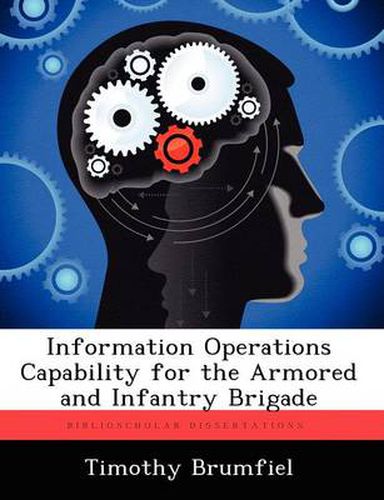
Presently, no organic information operations (IO) capability exists in the organization and structure of the armored and infantry brigade, so these brigades are unable to effectively plan, integrate, and coordinate IO activities into the brigade’s operations without assistance. As the Army transforms to a more modular force that will rely heavily on the ability of brigades to conduct operations using assets normally associated with higher echelons or services, this capability becomes more relevant to the brigade to ensure success. This study analyzed field manuals, after-action reviews, lessons learned, and professional articles to determine the importance of IO to the brigade and to ascertain if a need existed for brigades to have their own ability to plan and coordinate IO activities. A survey was utilized to gain opinion from Army field grade officers attending the Army’s Command and General Staff College (CGSC) to confirm the need for IO at brigade level. The study then provided a potential solution to the organizational structure that should be organic to the brigade to provide the needed IO capability. Based on the research conducted, evidence exists that there is a need for a trained, permanent IO staff member at the brigade level who can ensure that IO is fully planned, coordinated, and integrated into the brigade’s missions and operations.
$9.00 standard shipping within Australia
FREE standard shipping within Australia for orders over $100.00
Express & International shipping calculated at checkout
Stock availability can be subject to change without notice. We recommend calling the shop or contacting our online team to check availability of low stock items. Please see our Shopping Online page for more details.
This title is printed to order. This book may have been self-published. If so, we cannot guarantee the quality of the content. In the main most books will have gone through the editing process however some may not. We therefore suggest that you be aware of this before ordering this book. If in doubt check either the author or publisher’s details as we are unable to accept any returns unless they are faulty. Please contact us if you have any questions.
Presently, no organic information operations (IO) capability exists in the organization and structure of the armored and infantry brigade, so these brigades are unable to effectively plan, integrate, and coordinate IO activities into the brigade’s operations without assistance. As the Army transforms to a more modular force that will rely heavily on the ability of brigades to conduct operations using assets normally associated with higher echelons or services, this capability becomes more relevant to the brigade to ensure success. This study analyzed field manuals, after-action reviews, lessons learned, and professional articles to determine the importance of IO to the brigade and to ascertain if a need existed for brigades to have their own ability to plan and coordinate IO activities. A survey was utilized to gain opinion from Army field grade officers attending the Army’s Command and General Staff College (CGSC) to confirm the need for IO at brigade level. The study then provided a potential solution to the organizational structure that should be organic to the brigade to provide the needed IO capability. Based on the research conducted, evidence exists that there is a need for a trained, permanent IO staff member at the brigade level who can ensure that IO is fully planned, coordinated, and integrated into the brigade’s missions and operations.
Search our extensive online catalogue.
