Readings Newsletter
Become a Readings Member to make your shopping experience even easier.
Sign in or sign up for free!
You’re not far away from qualifying for FREE standard shipping within Australia
You’ve qualified for FREE standard shipping within Australia
The cart is loading…


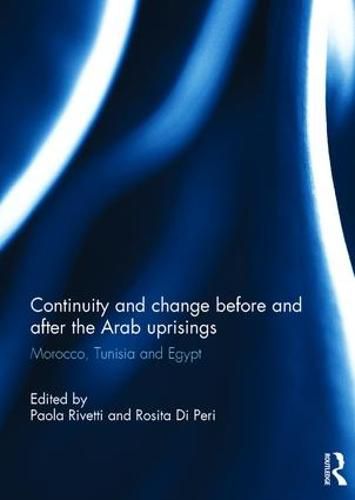
The Arab uprisings of 2011 have sparked much scholarly discussion with regards to democratisation, the resilience of authoritarian rule, mobilisation patterns, and the relationship between secularism and Islam, all under the assumption that politics has changed for good in North Africa and the Middle East. While acknowledging the post-2011 transformations taking place in the region, this book brings to the forefront an understudied, yet crucial, aspect related to the uprisings, namely the interplay between continuity and change.
Challenging simplified representations built around the positions that either ‘all has changed’ or ‘nothing has changed’, the in-depth case studies in this volume demonstrate how elements both of continuity, and rupture with the past, are present in the post-uprising landscapes of Morocco, Tunisia and Egypt. Public policy, contentious politics, the process of institution making and re-making, and the relations of power connecting national and international economies are at the core of the comparative investigations included in the book. The volume makes an important contribution to the study of North African politics, and to the study of political change and stability, by contrasting the different trajectories of the uprisings, and by offering theoretical reflections on their meaning, consequences and scope. This book was originally published as a special issue of the British Journal of Middle Eastern Studies.
$9.00 standard shipping within Australia
FREE standard shipping within Australia for orders over $100.00
Express & International shipping calculated at checkout
Stock availability can be subject to change without notice. We recommend calling the shop or contacting our online team to check availability of low stock items. Please see our Shopping Online page for more details.
The Arab uprisings of 2011 have sparked much scholarly discussion with regards to democratisation, the resilience of authoritarian rule, mobilisation patterns, and the relationship between secularism and Islam, all under the assumption that politics has changed for good in North Africa and the Middle East. While acknowledging the post-2011 transformations taking place in the region, this book brings to the forefront an understudied, yet crucial, aspect related to the uprisings, namely the interplay between continuity and change.
Challenging simplified representations built around the positions that either ‘all has changed’ or ‘nothing has changed’, the in-depth case studies in this volume demonstrate how elements both of continuity, and rupture with the past, are present in the post-uprising landscapes of Morocco, Tunisia and Egypt. Public policy, contentious politics, the process of institution making and re-making, and the relations of power connecting national and international economies are at the core of the comparative investigations included in the book. The volume makes an important contribution to the study of North African politics, and to the study of political change and stability, by contrasting the different trajectories of the uprisings, and by offering theoretical reflections on their meaning, consequences and scope. This book was originally published as a special issue of the British Journal of Middle Eastern Studies.
Search our extensive online catalogue.
