Readings Newsletter
Become a Readings Member to make your shopping experience even easier.
Sign in or sign up for free!
You’re not far away from qualifying for FREE standard shipping within Australia
You’ve qualified for FREE standard shipping within Australia
The cart is loading…


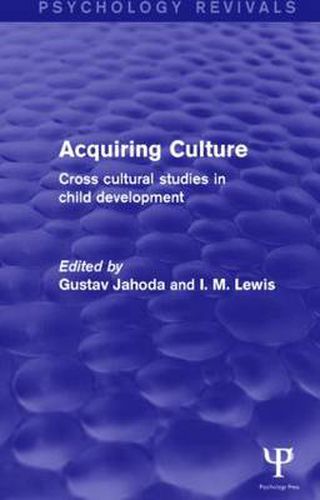
Until the 70s and 80s anthropologists studying different cultures had mainly confined themselves to the behaviour and idea systems of adults. Psychologists, on the other hand, working mainly in Europe and America, had studied child development in their own settings and simply assumed the universality of their findings. Thus both disciplines had largely ignored a crucial problem area: the way in which children from birth onwards learn to become competent members of their culture. This process, which has been called ‘the quintessential human adaptation’, constitutes the theme of this volume, originally published in 1988.
It derives from a workshop held at the London School of Economics which brought together fieldworkers who in their studies had paid more than usual attention to children in their cultures. Their experience and foci of interest were varied but this very diversity serves to illuminate different facets of the acquisition of culture by children, ranging in age from pre-verbal infants to adolescents.
Evolutionarily primed for culture-learning, children are responsive to a rich web of influences from subtle and indirect as in their music and dance to direct teaching in the family guided by culture-specific ideas about child psychology. Some of the salient things they learn relate to gender, status and power, critical for the functioning of all societies.
The introductory essay provides the necessary historical background of the development of child study in both anthropology and psychology and outlined how future research in the ethnography of childhood should proceed. The book concludes with an annotated bibliography providing a guide to the literature from 1970 onwards.
$9.00 standard shipping within Australia
FREE standard shipping within Australia for orders over $100.00
Express & International shipping calculated at checkout
Stock availability can be subject to change without notice. We recommend calling the shop or contacting our online team to check availability of low stock items. Please see our Shopping Online page for more details.
Until the 70s and 80s anthropologists studying different cultures had mainly confined themselves to the behaviour and idea systems of adults. Psychologists, on the other hand, working mainly in Europe and America, had studied child development in their own settings and simply assumed the universality of their findings. Thus both disciplines had largely ignored a crucial problem area: the way in which children from birth onwards learn to become competent members of their culture. This process, which has been called ‘the quintessential human adaptation’, constitutes the theme of this volume, originally published in 1988.
It derives from a workshop held at the London School of Economics which brought together fieldworkers who in their studies had paid more than usual attention to children in their cultures. Their experience and foci of interest were varied but this very diversity serves to illuminate different facets of the acquisition of culture by children, ranging in age from pre-verbal infants to adolescents.
Evolutionarily primed for culture-learning, children are responsive to a rich web of influences from subtle and indirect as in their music and dance to direct teaching in the family guided by culture-specific ideas about child psychology. Some of the salient things they learn relate to gender, status and power, critical for the functioning of all societies.
The introductory essay provides the necessary historical background of the development of child study in both anthropology and psychology and outlined how future research in the ethnography of childhood should proceed. The book concludes with an annotated bibliography providing a guide to the literature from 1970 onwards.
Search our extensive online catalogue.
