Readings Newsletter
Become a Readings Member to make your shopping experience even easier.
Sign in or sign up for free!
You’re not far away from qualifying for FREE standard shipping within Australia
You’ve qualified for FREE standard shipping within Australia
The cart is loading…


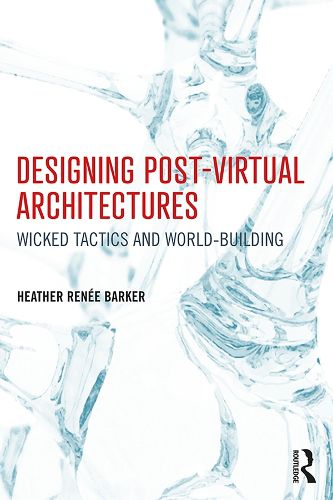
Designing Post-Virtual Architectures: Wicked Tactics and World-Building explores, describes, and demonstrates theories and strategies for design in a post-virtual world. This book reveals affinities among social, mathematical, philosophical, and language expressions integrated into a theoretical framework, facilitating design across physical and virtual space. This experience-driven framework forms the basis for data-driven, experience design methodologies. The implementation of these methodologies takes design work beyond the stylistic expressions of parameters, to data-driven, multi-modal, parametric processes of transformation.
With this book as a resource, architects and designers have a handbook of technical and philosophical concepts to lend rigor to their design work. Numerous diagrams delineate complex ideas while also acting as templates for creating, assessing, and communicating the meaning and value of designed solutions. As a handbook, the intention is to provide a guide to support the application of interdisciplinary tactics across strategic fields. Such novel approaches open up new ways of developing singular solutions and new ways to serve the distributed behaviours systemized through architectures. In an evolving contemporary condition, a foundation of rigorous human-centred design is central to moving the discipline of design into the future.
Providing a range of rigorous methodologies for those looking to develop project-specific strategies, Designing Post-Virtual Architectures: Wicked Tactics and World-Building is a tool to facilitate the creation of innovative and meaningful architectures, and is an ideal resource for postgraduate students of architectural theory, design theory and design methods, as well as academics and professionals practicing the field.
$9.00 standard shipping within Australia
FREE standard shipping within Australia for orders over $100.00
Express & International shipping calculated at checkout
Stock availability can be subject to change without notice. We recommend calling the shop or contacting our online team to check availability of low stock items. Please see our Shopping Online page for more details.
Designing Post-Virtual Architectures: Wicked Tactics and World-Building explores, describes, and demonstrates theories and strategies for design in a post-virtual world. This book reveals affinities among social, mathematical, philosophical, and language expressions integrated into a theoretical framework, facilitating design across physical and virtual space. This experience-driven framework forms the basis for data-driven, experience design methodologies. The implementation of these methodologies takes design work beyond the stylistic expressions of parameters, to data-driven, multi-modal, parametric processes of transformation.
With this book as a resource, architects and designers have a handbook of technical and philosophical concepts to lend rigor to their design work. Numerous diagrams delineate complex ideas while also acting as templates for creating, assessing, and communicating the meaning and value of designed solutions. As a handbook, the intention is to provide a guide to support the application of interdisciplinary tactics across strategic fields. Such novel approaches open up new ways of developing singular solutions and new ways to serve the distributed behaviours systemized through architectures. In an evolving contemporary condition, a foundation of rigorous human-centred design is central to moving the discipline of design into the future.
Providing a range of rigorous methodologies for those looking to develop project-specific strategies, Designing Post-Virtual Architectures: Wicked Tactics and World-Building is a tool to facilitate the creation of innovative and meaningful architectures, and is an ideal resource for postgraduate students of architectural theory, design theory and design methods, as well as academics and professionals practicing the field.
Search our extensive online catalogue.
