Readings Newsletter
Become a Readings Member to make your shopping experience even easier.
Sign in or sign up for free!
You’re not far away from qualifying for FREE standard shipping within Australia
You’ve qualified for FREE standard shipping within Australia
The cart is loading…


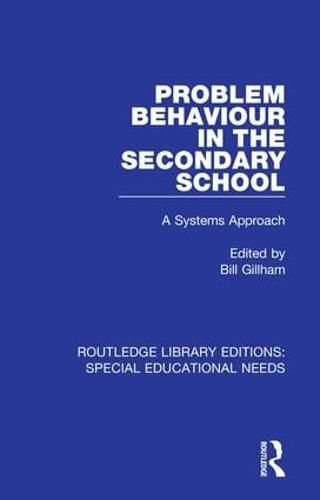
First published in 1981. The inadequacy of traditional ‘solutions’ is nowhere more apparent than in the area of problem behaviour in secondary schools. Neither tough-minded punishment nor tender-minded treatment seems to be the answer. But the practical failure is also a theoretical one, since it misconstrues the determinants of behaviour.
Taking a system perspective, Bill Gillham argues in his introductory chapter that ‘our conception of the individual has been too narrow’, so that both treatment and punishment approaches have missed out important elements in an adequate psychology of individuals: the roles they fill, the tasks they perform, the people they encounter - and the institutional settings where all these are experienced.
Drawing together a wide range of theory, evidence and practice, the present book makes out a case for a school-centred, interactionist, approach to dealing with problem behaviour.
$9.00 standard shipping within Australia
FREE standard shipping within Australia for orders over $100.00
Express & International shipping calculated at checkout
Stock availability can be subject to change without notice. We recommend calling the shop or contacting our online team to check availability of low stock items. Please see our Shopping Online page for more details.
First published in 1981. The inadequacy of traditional ‘solutions’ is nowhere more apparent than in the area of problem behaviour in secondary schools. Neither tough-minded punishment nor tender-minded treatment seems to be the answer. But the practical failure is also a theoretical one, since it misconstrues the determinants of behaviour.
Taking a system perspective, Bill Gillham argues in his introductory chapter that ‘our conception of the individual has been too narrow’, so that both treatment and punishment approaches have missed out important elements in an adequate psychology of individuals: the roles they fill, the tasks they perform, the people they encounter - and the institutional settings where all these are experienced.
Drawing together a wide range of theory, evidence and practice, the present book makes out a case for a school-centred, interactionist, approach to dealing with problem behaviour.
Search our extensive online catalogue.
