Readings Newsletter
Become a Readings Member to make your shopping experience even easier.
Sign in or sign up for free!
You’re not far away from qualifying for FREE standard shipping within Australia
You’ve qualified for FREE standard shipping within Australia
The cart is loading…


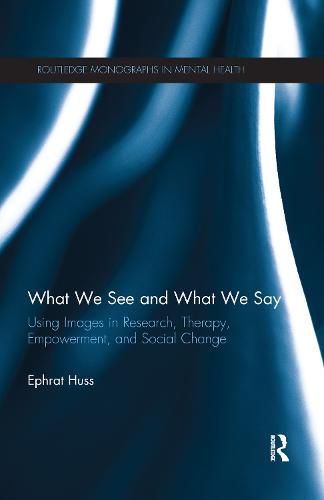
Image-based research methods, such as arts-based research, can fill the absence of the voice of impoverished, under-privileged populations. In What We See and What We Say, Ephrat Huss argues that images are deep and universally psycho-neurological constructs through which people process their experiences. The theoretical model demonstrated in this book demonstrates that images can be used to enable three different levels of communication: with self, with others similar to oneself, and with others who differ in terms of culture and power. Dr. Huss centers her argument on a case study of impoverished Bedouin women’s groups in Israel who used art as self-expression, and includes many additional examples such as unemployed women and teenage girls in slums, women who have underwent sexual abuse, and the experiences of illegal immigrants. Ultimately, the author points to how the inherent structural characteristics of images help to intensify the voices of marginalized groups in research, therapy, empowerment, and social action.
$9.00 standard shipping within Australia
FREE standard shipping within Australia for orders over $100.00
Express & International shipping calculated at checkout
Stock availability can be subject to change without notice. We recommend calling the shop or contacting our online team to check availability of low stock items. Please see our Shopping Online page for more details.
Image-based research methods, such as arts-based research, can fill the absence of the voice of impoverished, under-privileged populations. In What We See and What We Say, Ephrat Huss argues that images are deep and universally psycho-neurological constructs through which people process their experiences. The theoretical model demonstrated in this book demonstrates that images can be used to enable three different levels of communication: with self, with others similar to oneself, and with others who differ in terms of culture and power. Dr. Huss centers her argument on a case study of impoverished Bedouin women’s groups in Israel who used art as self-expression, and includes many additional examples such as unemployed women and teenage girls in slums, women who have underwent sexual abuse, and the experiences of illegal immigrants. Ultimately, the author points to how the inherent structural characteristics of images help to intensify the voices of marginalized groups in research, therapy, empowerment, and social action.
Search our extensive online catalogue.
