Readings Newsletter
Become a Readings Member to make your shopping experience even easier.
Sign in or sign up for free!
You’re not far away from qualifying for FREE standard shipping within Australia
You’ve qualified for FREE standard shipping within Australia
The cart is loading…


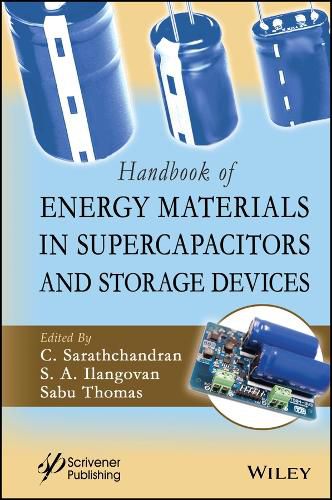
Accelerate your understanding of modern energy storage with this one-stop resource that provides a comprehensive guide to the basics, materials, and recent advancements in high-efficiency supercapacitor technology.
The increasing population, environmental pollution, and growing demand for energy underscores the importance of highly efficient energy storage devices. Supercapacitors, often referred to as ultracapacitors, have emerged as a pivotal technology in the realm of energy storage. Increasing demand for supercapacitors arises from the high energy density required by various modern applications like electric vehicles, UPS systems, wind turbines, space vehicles, regenerative braking, load leveling systems, etc. The above-mentioned applications require an improvement in working voltage (by preventing/reducing reaction between electrode and electrolyte surface), specific capacitance, and energy density (by increasing the surface area, addition of transition metal oxides/conducting polymers, etc.) of the existing supercapacitors. Global research is directed towards blending the high energy density of batteries with the high-power density of traditional capacitors, thereby enabling the supercapacitors to be ideal for applications demanding rapid charge and discharge cycles, high power output, and long cycle life.
This book is designed to cover the basics of supercapacitors and provide a current account of the recent advances in this field. It provides the basics of various materials, different stages of growth in this field, and recent developments, making it a one-stop resource for understanding and advancing the field of supercapacitor technology.
Readers will find in the volume;
A detailed explanation of the electrochemical processes and energy storage mechanisms in supercapacitors, with a detailed introduction to supercapacitors; A comprehensive review of various electrode materials, including carbon-based materials, metal oxides, and conducting polymers; A detailed discussion on different electrolyte types (aqueous, organic, and ionic liquids) and their impact on supercapacitor performance; An exploration of the design considerations and manufacturing techniques for supercapacitors.
Audience
The book will be a valuable resource for researchers, engineers, and industry professionals involved in various fields, including electronics, automotive, renewable energy, and grid storage.
$9.00 standard shipping within Australia
FREE standard shipping within Australia for orders over $100.00
Express & International shipping calculated at checkout
Stock availability can be subject to change without notice. We recommend calling the shop or contacting our online team to check availability of low stock items. Please see our Shopping Online page for more details.
Accelerate your understanding of modern energy storage with this one-stop resource that provides a comprehensive guide to the basics, materials, and recent advancements in high-efficiency supercapacitor technology.
The increasing population, environmental pollution, and growing demand for energy underscores the importance of highly efficient energy storage devices. Supercapacitors, often referred to as ultracapacitors, have emerged as a pivotal technology in the realm of energy storage. Increasing demand for supercapacitors arises from the high energy density required by various modern applications like electric vehicles, UPS systems, wind turbines, space vehicles, regenerative braking, load leveling systems, etc. The above-mentioned applications require an improvement in working voltage (by preventing/reducing reaction between electrode and electrolyte surface), specific capacitance, and energy density (by increasing the surface area, addition of transition metal oxides/conducting polymers, etc.) of the existing supercapacitors. Global research is directed towards blending the high energy density of batteries with the high-power density of traditional capacitors, thereby enabling the supercapacitors to be ideal for applications demanding rapid charge and discharge cycles, high power output, and long cycle life.
This book is designed to cover the basics of supercapacitors and provide a current account of the recent advances in this field. It provides the basics of various materials, different stages of growth in this field, and recent developments, making it a one-stop resource for understanding and advancing the field of supercapacitor technology.
Readers will find in the volume;
A detailed explanation of the electrochemical processes and energy storage mechanisms in supercapacitors, with a detailed introduction to supercapacitors; A comprehensive review of various electrode materials, including carbon-based materials, metal oxides, and conducting polymers; A detailed discussion on different electrolyte types (aqueous, organic, and ionic liquids) and their impact on supercapacitor performance; An exploration of the design considerations and manufacturing techniques for supercapacitors.
Audience
The book will be a valuable resource for researchers, engineers, and industry professionals involved in various fields, including electronics, automotive, renewable energy, and grid storage.
Search our extensive online catalogue.
