Readings Newsletter
Become a Readings Member to make your shopping experience even easier.
Sign in or sign up for free!
You’re not far away from qualifying for FREE standard shipping within Australia
You’ve qualified for FREE standard shipping within Australia
The cart is loading…


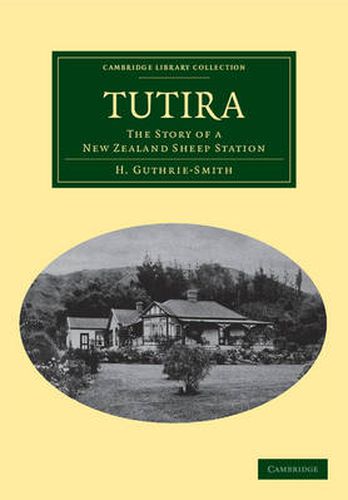
In 1880, William Herbert Guthrie-Smith (1862-1940) emigrated from Scotland to New Zealand, where he learned the basics of sheep farming and acquired Tutira, a disused sheep station of 20,000 acres in the Hawke’s Bay region of the North Island. Tutira, published in 1921, describes every aspect of Guthrie-Smith’s enterprise, including the redevelopment of the land and comprehensive advice on sheep farming. The book also covers the history of the local Maori and of European settlement, and provides an extensive account of the farm’s natural history including its geological configuration, meteorological patterns, the formation of lakes and waterways, and the native plant and bird species Guthrie-Smith discovered on his land. It also draws attention to the impact of introduced, ‘alien’ plants and animals. Tutira is one of the great classics of New World environmental consciousness; it was reprinted in 1926, and a posthumous revised edition appeared in 1953.
$9.00 standard shipping within Australia
FREE standard shipping within Australia for orders over $100.00
Express & International shipping calculated at checkout
Stock availability can be subject to change without notice. We recommend calling the shop or contacting our online team to check availability of low stock items. Please see our Shopping Online page for more details.
In 1880, William Herbert Guthrie-Smith (1862-1940) emigrated from Scotland to New Zealand, where he learned the basics of sheep farming and acquired Tutira, a disused sheep station of 20,000 acres in the Hawke’s Bay region of the North Island. Tutira, published in 1921, describes every aspect of Guthrie-Smith’s enterprise, including the redevelopment of the land and comprehensive advice on sheep farming. The book also covers the history of the local Maori and of European settlement, and provides an extensive account of the farm’s natural history including its geological configuration, meteorological patterns, the formation of lakes and waterways, and the native plant and bird species Guthrie-Smith discovered on his land. It also draws attention to the impact of introduced, ‘alien’ plants and animals. Tutira is one of the great classics of New World environmental consciousness; it was reprinted in 1926, and a posthumous revised edition appeared in 1953.
Search our extensive online catalogue.
