Readings Newsletter
Become a Readings Member to make your shopping experience even easier.
Sign in or sign up for free!
You’re not far away from qualifying for FREE standard shipping within Australia
You’ve qualified for FREE standard shipping within Australia
The cart is loading…


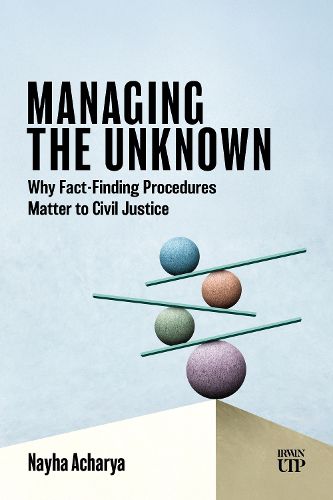
Managing the Unknown inquires into the legitimacy of judicial fact-finding in civil litigation. In deciding a case, judges must determine, authoritatively, "what happened?" based on whatever fragmented evidence is available. Given the inevitability of factual uncertainty, there is no guarantee of accuracy, only an assurance that the finding is "more likely than not" correct. On what basis, then, do we accept the authority of judicial fact-finding?
Probing key jurisprudential ideas, law professor Nayha Acharya outlines the crucial role of procedural integrity by showing that the legitimacy of legal outcomes, including factual findings, is rooted in the propriety of their underlying processes. To maintain legitimate authority, legal procedures must demonstrably respect human dignity which includes ensuring that we are treated as equal, autonomous agents. Accordingly, the legitimacy of fact-finding depends on a process that respects the autonomy and equality of legal subjects, which means it is a factually reliable and fully participatory model. By positing the centrality of process in the legitimacy of judicial fact-finding, and given that fact-finding is a central element of law practice, this book invites all legal players from students to practitioners to reflect deeply on their role in maintaining procedural integrity and rule of law.
$9.00 standard shipping within Australia
FREE standard shipping within Australia for orders over $100.00
Express & International shipping calculated at checkout
Stock availability can be subject to change without notice. We recommend calling the shop or contacting our online team to check availability of low stock items. Please see our Shopping Online page for more details.
Managing the Unknown inquires into the legitimacy of judicial fact-finding in civil litigation. In deciding a case, judges must determine, authoritatively, "what happened?" based on whatever fragmented evidence is available. Given the inevitability of factual uncertainty, there is no guarantee of accuracy, only an assurance that the finding is "more likely than not" correct. On what basis, then, do we accept the authority of judicial fact-finding?
Probing key jurisprudential ideas, law professor Nayha Acharya outlines the crucial role of procedural integrity by showing that the legitimacy of legal outcomes, including factual findings, is rooted in the propriety of their underlying processes. To maintain legitimate authority, legal procedures must demonstrably respect human dignity which includes ensuring that we are treated as equal, autonomous agents. Accordingly, the legitimacy of fact-finding depends on a process that respects the autonomy and equality of legal subjects, which means it is a factually reliable and fully participatory model. By positing the centrality of process in the legitimacy of judicial fact-finding, and given that fact-finding is a central element of law practice, this book invites all legal players from students to practitioners to reflect deeply on their role in maintaining procedural integrity and rule of law.
Search our extensive online catalogue.
