Readings Newsletter
Become a Readings Member to make your shopping experience even easier.
Sign in or sign up for free!
You’re not far away from qualifying for FREE standard shipping within Australia
You’ve qualified for FREE standard shipping within Australia
The cart is loading…


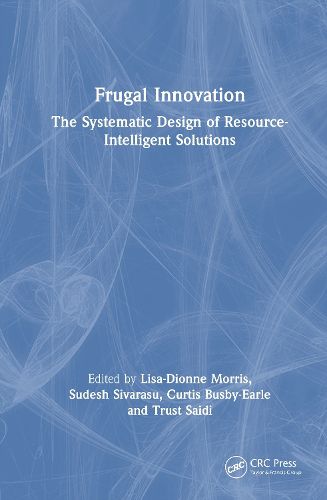
Frugal Innovation: The Systematic Design of Resource-Intelligent Solutions advocates for a systematic approach to developing impactful, resource-efficient solutions in low-resource and high-resource settings. It integrates frugal innovation principles with design thinking and lean impact strategies, bridging the gap between theory and practice. This book explores themes like resource-constrained design, iterative development, and stakeholder-centric innovation, aligning with global challenges like environmental sustainability and global inequality, and aligning with global agendas like the SDGs.
This book combines theoretical insights with real-world case studies to demonstrate how systematic processes-spanning needs assessment, stakeholder engagement, prototyping, and scaling-can address complex social challenges sustainably. It emphasizes achieving maximum impact with minimal resources, ensuring solutions are efficient, accessible, and relevant across diverse socio-economic contexts. With a blend of conceptual depth and practical tools, the book provides repeatable steps for designing cost-effective, scalable, and context-appropriate solutions. Key concepts like resource-intelligent design, lean experimentation, and stakeholder-centric innovation are illustrated through case studies, showing how abstract ideas are applied in real-world social and technological settings.
Ideal for designers, engineers, social innovators, and professionals in social enterprise, sustainable development, and humanitarian design, offering guidance on driving inclusive, scalable progress within real-world constraints. Edited by experts in fields like biomedical innovation, systems thinking, and co-created health technologies, it equips readers to design technically robust and socially responsive solutions for meaningful impact.
$9.00 standard shipping within Australia
FREE standard shipping within Australia for orders over $100.00
Express & International shipping calculated at checkout
Stock availability can be subject to change without notice. We recommend calling the shop or contacting our online team to check availability of low stock items. Please see our Shopping Online page for more details.
Frugal Innovation: The Systematic Design of Resource-Intelligent Solutions advocates for a systematic approach to developing impactful, resource-efficient solutions in low-resource and high-resource settings. It integrates frugal innovation principles with design thinking and lean impact strategies, bridging the gap between theory and practice. This book explores themes like resource-constrained design, iterative development, and stakeholder-centric innovation, aligning with global challenges like environmental sustainability and global inequality, and aligning with global agendas like the SDGs.
This book combines theoretical insights with real-world case studies to demonstrate how systematic processes-spanning needs assessment, stakeholder engagement, prototyping, and scaling-can address complex social challenges sustainably. It emphasizes achieving maximum impact with minimal resources, ensuring solutions are efficient, accessible, and relevant across diverse socio-economic contexts. With a blend of conceptual depth and practical tools, the book provides repeatable steps for designing cost-effective, scalable, and context-appropriate solutions. Key concepts like resource-intelligent design, lean experimentation, and stakeholder-centric innovation are illustrated through case studies, showing how abstract ideas are applied in real-world social and technological settings.
Ideal for designers, engineers, social innovators, and professionals in social enterprise, sustainable development, and humanitarian design, offering guidance on driving inclusive, scalable progress within real-world constraints. Edited by experts in fields like biomedical innovation, systems thinking, and co-created health technologies, it equips readers to design technically robust and socially responsive solutions for meaningful impact.
Search our extensive online catalogue.
