Readings Newsletter
Become a Readings Member to make your shopping experience even easier.
Sign in or sign up for free!
You’re not far away from qualifying for FREE standard shipping within Australia
You’ve qualified for FREE standard shipping within Australia
The cart is loading…


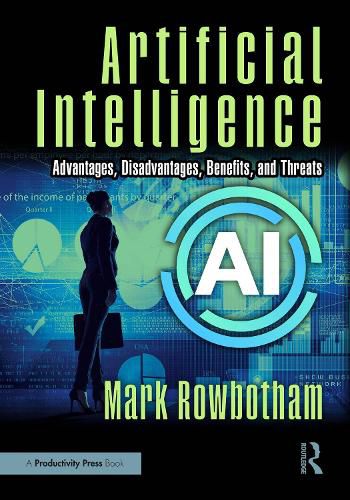
This book introduces the subject of artificial intelligence (AI), its structures, uses, application to the artificial neural network, technology applications, and the advantages and disadvantages of its use, including its potential weaknesses and drawbacks. AI, in its broadest sense, is intelligence exhibited by machines, particularly computer systems. It is a field of research in computer science that develops and studies methods and software that enable machines to perceive their environment and use learning and intelligence to take actions that maximize their chances of achieving defined goals. Such machines may be called AIs. AI technology is widely used throughout industry, government, and science.
Some high-profile applications include advanced web search engines (e.g., Google Search); recommendation systems (used by platforms such as YouTube, Amazon, and Netflix); interacting via human speech (e.g., Google Assistant, Siri, and Alexa); autonomous vehicles (e.g., Waymo); generative and creative tools (e.g., ChatGPT, Apple Intelligence, and AI art); and superhuman play and analysis in strategy games (e.g., chess and Go). However, many AI applications are not perceived as AI. It would appear that much of specific AI has filtered into general applications, often without being called AI because once something becomes useful and common enough, it is no longer labelled as AI.
The growing use of AI in the 21st century is influencing a societal and economic shift towards increased automation, data-driven decision-making, and the integration of AI systems into various economic and commercial sectors and areas of everyday life. Its impact is felt across job markets, healthcare, government, industry, education, propaganda, and disinformation and deception, whether deliberate or otherwise. This raises questions about the long-term effects, ethical implications, and risks of AI, prompting discussions about regulatory policies to ensure the safety and benefits of the technology.
$9.00 standard shipping within Australia
FREE standard shipping within Australia for orders over $100.00
Express & International shipping calculated at checkout
Stock availability can be subject to change without notice. We recommend calling the shop or contacting our online team to check availability of low stock items. Please see our Shopping Online page for more details.
This book introduces the subject of artificial intelligence (AI), its structures, uses, application to the artificial neural network, technology applications, and the advantages and disadvantages of its use, including its potential weaknesses and drawbacks. AI, in its broadest sense, is intelligence exhibited by machines, particularly computer systems. It is a field of research in computer science that develops and studies methods and software that enable machines to perceive their environment and use learning and intelligence to take actions that maximize their chances of achieving defined goals. Such machines may be called AIs. AI technology is widely used throughout industry, government, and science.
Some high-profile applications include advanced web search engines (e.g., Google Search); recommendation systems (used by platforms such as YouTube, Amazon, and Netflix); interacting via human speech (e.g., Google Assistant, Siri, and Alexa); autonomous vehicles (e.g., Waymo); generative and creative tools (e.g., ChatGPT, Apple Intelligence, and AI art); and superhuman play and analysis in strategy games (e.g., chess and Go). However, many AI applications are not perceived as AI. It would appear that much of specific AI has filtered into general applications, often without being called AI because once something becomes useful and common enough, it is no longer labelled as AI.
The growing use of AI in the 21st century is influencing a societal and economic shift towards increased automation, data-driven decision-making, and the integration of AI systems into various economic and commercial sectors and areas of everyday life. Its impact is felt across job markets, healthcare, government, industry, education, propaganda, and disinformation and deception, whether deliberate or otherwise. This raises questions about the long-term effects, ethical implications, and risks of AI, prompting discussions about regulatory policies to ensure the safety and benefits of the technology.
Search our extensive online catalogue.
