Readings Newsletter
Become a Readings Member to make your shopping experience even easier.
Sign in or sign up for free!
You’re not far away from qualifying for FREE standard shipping within Australia
You’ve qualified for FREE standard shipping within Australia
The cart is loading…


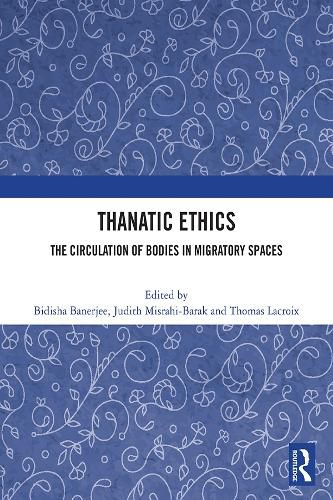
This book emerges from "Thanatic Ethics: The Circulation of Bodies in Migratory Spaces", an interdisciplinary and transdisciplinary project uniting social scientists, postcolonial scholars, and artists worldwide to raise critical issues related to the death of migrants. It urgently calls for migration studies to confront the consequences of Western governments' restrictive and necropolitical migration policies.
The volume introduces thanatic ethics as a moral compass-a code of conduct that re-endows migrant deaths with meaning, ensuring they are remembered and mourned. Through diverse perspectives, contributors examine how social practices, political mobilizations, and artistic and literary representations can serve dual purposes: memorializing the dead while changing the gaze of the living on the unidentified dead. Enhancing awareness in the wider community could lead to the overturning of current migration policies.
Thoughtfully organized into four sections, the book first explores how oceanic waters have been constructed as bordering agents-spaces of exclusion and death. The second section focuses on the politics of death, burial, and mourning, while the third confronts the fraught questions inherent to visualizing the Thanatic. The concluding section advances essential conversations about care, repair, and restitution.
This essential text speaks to a diverse audience including scholars and students in migration studies, postcolonial studies, human rights, ethics, cultural studies, literature, and political science. It will also prove valuable for policymakers, human rights advocates, artists, and anyone concerned with the multi-layered aspects of migration.
The chapters in this book were originally published as a special issue of Interventions: International Journal of Postcolonial Studies.
$9.00 standard shipping within Australia
FREE standard shipping within Australia for orders over $100.00
Express & International shipping calculated at checkout
Stock availability can be subject to change without notice. We recommend calling the shop or contacting our online team to check availability of low stock items. Please see our Shopping Online page for more details.
This book emerges from "Thanatic Ethics: The Circulation of Bodies in Migratory Spaces", an interdisciplinary and transdisciplinary project uniting social scientists, postcolonial scholars, and artists worldwide to raise critical issues related to the death of migrants. It urgently calls for migration studies to confront the consequences of Western governments' restrictive and necropolitical migration policies.
The volume introduces thanatic ethics as a moral compass-a code of conduct that re-endows migrant deaths with meaning, ensuring they are remembered and mourned. Through diverse perspectives, contributors examine how social practices, political mobilizations, and artistic and literary representations can serve dual purposes: memorializing the dead while changing the gaze of the living on the unidentified dead. Enhancing awareness in the wider community could lead to the overturning of current migration policies.
Thoughtfully organized into four sections, the book first explores how oceanic waters have been constructed as bordering agents-spaces of exclusion and death. The second section focuses on the politics of death, burial, and mourning, while the third confronts the fraught questions inherent to visualizing the Thanatic. The concluding section advances essential conversations about care, repair, and restitution.
This essential text speaks to a diverse audience including scholars and students in migration studies, postcolonial studies, human rights, ethics, cultural studies, literature, and political science. It will also prove valuable for policymakers, human rights advocates, artists, and anyone concerned with the multi-layered aspects of migration.
The chapters in this book were originally published as a special issue of Interventions: International Journal of Postcolonial Studies.
Search our extensive online catalogue.
