Readings Newsletter
Become a Readings Member to make your shopping experience even easier.
Sign in or sign up for free!
You’re not far away from qualifying for FREE standard shipping within Australia
You’ve qualified for FREE standard shipping within Australia
The cart is loading…


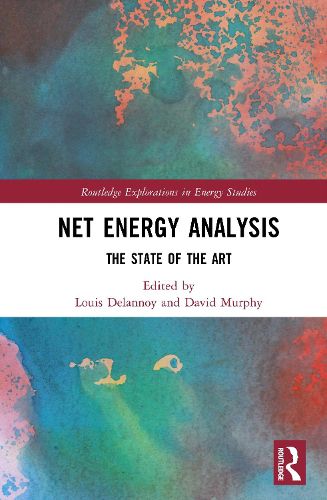
This book offers a comprehensive synthesis of recent advances in Net Energy Analysis (NEA), bridging gaps in the literature, integrating insights from multiple disciplines, and providing practical tools for future research.
Modern societies are built upon energy and, more precisely, net energy-the energy available after accounting for the energy required to build, operate, and maintain the energy system. NEA provides the science to assess net energy and its implications, often through the concept of energy return on investment (EROI). Over the past five decades, NEA has expanded from early EROI studies into a toolkit spanning process-based accounting, input-output analysis, hybrid methods, and system-wide assessments. This toolkit is increasingly used to evaluate transition pathways, yet the field still lacks a comprehensive synthesis. Net Energy Analysis: The State of the Art brings together leading scholars to clarify the definitions, concepts, metrics, and methods that define contemporary NEA, while also exploring connections with adjacent fields such as evolutionary biology, industrial ecology, and ecological economics. Part I examines different interpretations of net energy analysis, tracing its development from historical foundations to its relevance in financial markets and economics. Part II focuses on converging methodologies, including process-based approaches, input-output analysis, and a taxonomy of net energy metrics. Parts III and IV move into more advanced applications and emerging frontiers, such as system-level EROI estimation and the integration of net energy concepts into Integrated Assessment Models (IAMs), among others.
The book will be a useful resource for students in energy and sustainability, whilst also offering both new and experienced scholars a concise summary of key debates and the latest cutting-edge contributions relevant to their research.
The Open Access version of this book, available at http://www.taylorfrancis.com, has been made available under a Creative Commons [Attribution-Non Commercial-No Derivatives (CC BY-NC-ND)] 4.0 license.
$9.00 standard shipping within Australia
FREE standard shipping within Australia for orders over $100.00
Express & International shipping calculated at checkout
Stock availability can be subject to change without notice. We recommend calling the shop or contacting our online team to check availability of low stock items. Please see our Shopping Online page for more details.
This book offers a comprehensive synthesis of recent advances in Net Energy Analysis (NEA), bridging gaps in the literature, integrating insights from multiple disciplines, and providing practical tools for future research.
Modern societies are built upon energy and, more precisely, net energy-the energy available after accounting for the energy required to build, operate, and maintain the energy system. NEA provides the science to assess net energy and its implications, often through the concept of energy return on investment (EROI). Over the past five decades, NEA has expanded from early EROI studies into a toolkit spanning process-based accounting, input-output analysis, hybrid methods, and system-wide assessments. This toolkit is increasingly used to evaluate transition pathways, yet the field still lacks a comprehensive synthesis. Net Energy Analysis: The State of the Art brings together leading scholars to clarify the definitions, concepts, metrics, and methods that define contemporary NEA, while also exploring connections with adjacent fields such as evolutionary biology, industrial ecology, and ecological economics. Part I examines different interpretations of net energy analysis, tracing its development from historical foundations to its relevance in financial markets and economics. Part II focuses on converging methodologies, including process-based approaches, input-output analysis, and a taxonomy of net energy metrics. Parts III and IV move into more advanced applications and emerging frontiers, such as system-level EROI estimation and the integration of net energy concepts into Integrated Assessment Models (IAMs), among others.
The book will be a useful resource for students in energy and sustainability, whilst also offering both new and experienced scholars a concise summary of key debates and the latest cutting-edge contributions relevant to their research.
The Open Access version of this book, available at http://www.taylorfrancis.com, has been made available under a Creative Commons [Attribution-Non Commercial-No Derivatives (CC BY-NC-ND)] 4.0 license.
Search our extensive online catalogue.
