Readings Newsletter
Become a Readings Member to make your shopping experience even easier.
Sign in or sign up for free!
You’re not far away from qualifying for FREE standard shipping within Australia
You’ve qualified for FREE standard shipping within Australia
The cart is loading…


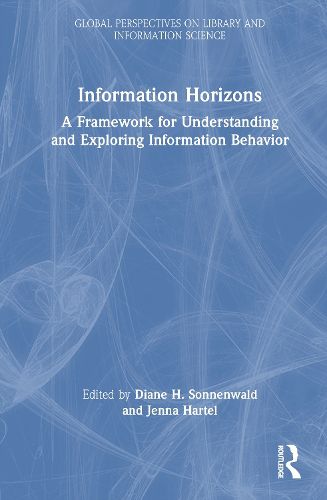
Information Horizons is the updated, definitive resource for the Information Horizon Theory and Information Horizon Interview method. Embracing behavioral, cognitive and social aspects of information, the theory and method have been applied globally in information behavior research and education.
The theory posits posits that information behavior is social, material, temporal, dynamic, situational and contextual, and that information behavior can be conceptualized as Information Horizons which include affordances and constraints on information behavior. It provides the foundation for the Information Horizon Interview method that combines semi-structured interview questions with a graphical elicitation technique in which the participant draws a visualization, or map, of their Information Horizon which illustrates their information seeking behavior in specific situations and context. This volume incorporates recent developments in scholarship, technology and methodology, updating the theory and method and providing new insights and guidance for their use in research and teaching. An expert in citation content analysis shows how the theory and method have been incorporated in research since its inception. Case studies authored by renowned scholars present personal reflections on their experiences conducting Information Horizon Interviews with different populations with a level of detail not possible within a standard research report. Extensive teaching and learning examples, with a focus on hands-on exercises, demonstrate how the theory and method are used to teach information behavior concepts. Essays by students recount their experiences learning about the Information Horizon Theory and conducting Information Horizon Interviews. The book concludes with two detailed Information Horizon Interview guides for different study populations.
Information Horizons will be of interest to researchers, educators, students, and practitioners worldwide interested in researching and teaching information behavior.
$9.00 standard shipping within Australia
FREE standard shipping within Australia for orders over $100.00
Express & International shipping calculated at checkout
Stock availability can be subject to change without notice. We recommend calling the shop or contacting our online team to check availability of low stock items. Please see our Shopping Online page for more details.
Information Horizons is the updated, definitive resource for the Information Horizon Theory and Information Horizon Interview method. Embracing behavioral, cognitive and social aspects of information, the theory and method have been applied globally in information behavior research and education.
The theory posits posits that information behavior is social, material, temporal, dynamic, situational and contextual, and that information behavior can be conceptualized as Information Horizons which include affordances and constraints on information behavior. It provides the foundation for the Information Horizon Interview method that combines semi-structured interview questions with a graphical elicitation technique in which the participant draws a visualization, or map, of their Information Horizon which illustrates their information seeking behavior in specific situations and context. This volume incorporates recent developments in scholarship, technology and methodology, updating the theory and method and providing new insights and guidance for their use in research and teaching. An expert in citation content analysis shows how the theory and method have been incorporated in research since its inception. Case studies authored by renowned scholars present personal reflections on their experiences conducting Information Horizon Interviews with different populations with a level of detail not possible within a standard research report. Extensive teaching and learning examples, with a focus on hands-on exercises, demonstrate how the theory and method are used to teach information behavior concepts. Essays by students recount their experiences learning about the Information Horizon Theory and conducting Information Horizon Interviews. The book concludes with two detailed Information Horizon Interview guides for different study populations.
Information Horizons will be of interest to researchers, educators, students, and practitioners worldwide interested in researching and teaching information behavior.
Search our extensive online catalogue.
