Readings Newsletter
Become a Readings Member to make your shopping experience even easier.
Sign in or sign up for free!
You’re not far away from qualifying for FREE standard shipping within Australia
You’ve qualified for FREE standard shipping within Australia
The cart is loading…


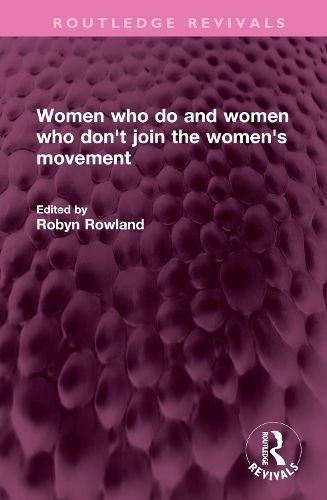
First published in 1984, Women who do and women who don't join the women's movement asks a variety of women - some of whom chose to align themselves with the women's movement, others who chose not to - to write about their lives and the reasons for choices they have made. Where do the differences lie in the experience of feminists and antifeminists? Can clear dividing lines be drawn which place two groups of strong, intelligent women on opposing sides in the battle to survive in a 'man's world'? In tackling these questions, the contributors create a diverse pattern of women's interpretations of 'being female', with, surprisingly, similarities emerging between the two groups, particularly in terms of their experience of 'self'. This book will be of interest to students of women's studies, gender studies and sociology.
$9.00 standard shipping within Australia
FREE standard shipping within Australia for orders over $100.00
Express & International shipping calculated at checkout
Stock availability can be subject to change without notice. We recommend calling the shop or contacting our online team to check availability of low stock items. Please see our Shopping Online page for more details.
First published in 1984, Women who do and women who don't join the women's movement asks a variety of women - some of whom chose to align themselves with the women's movement, others who chose not to - to write about their lives and the reasons for choices they have made. Where do the differences lie in the experience of feminists and antifeminists? Can clear dividing lines be drawn which place two groups of strong, intelligent women on opposing sides in the battle to survive in a 'man's world'? In tackling these questions, the contributors create a diverse pattern of women's interpretations of 'being female', with, surprisingly, similarities emerging between the two groups, particularly in terms of their experience of 'self'. This book will be of interest to students of women's studies, gender studies and sociology.
Search our extensive online catalogue.
