Readings Newsletter
Become a Readings Member to make your shopping experience even easier.
Sign in or sign up for free!
You’re not far away from qualifying for FREE standard shipping within Australia
You’ve qualified for FREE standard shipping within Australia
The cart is loading…


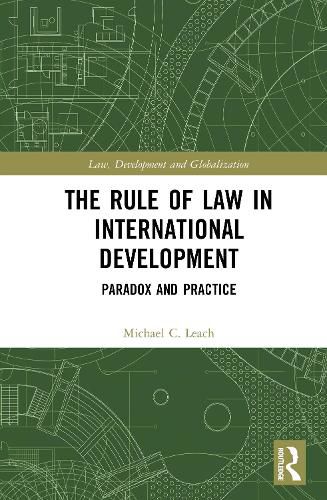
This book examines how the concept of the Rule of Law has been used in the field of international development over the past three decades.
In the early 1990s, the field of international development turned to law as a tool for socio-political transformation and economic reform. Within time, the legal-philosophical notion of the 'Rule of Law' emerged as the primary conceptual frame for that work. Although the Rule of Law is typically promoted as a transcendent, and universal value, development workers often express frustration with how hard it is to make sense of it in any specific or practical way. This makes it a paradox for any who work with it: while it is ubiquitous throughout international development policy and project work, it is also maddeningly elusive for those tasked with promoting it in practice. This book treats this paradox as an invitation to ask empirical questions about how development actors make use of the Rule of Law and what it means for them. Rather than trying to resolve this paradox with a new definition or conceptualization, the book instead argues that the Rule of Law became a powerful concept in development work because of, not despite, its lack of precise meaning. Informed by interviews with Rule of Law professionals, it challenges prevailing assumptions that value-laden concepts like the Rule of Law do the work of 'framing' international development practices. Instead, it demonstrates that the relationship between concept and practice is better understood inversely: it is international development itself that 'frames' how the Rule of Law has been rendered meaningful (and meaningless) in practice and that its many apparent paradoxes are a product of this.
The Rule of Law in International Development will appeal to scholars, practitioners, and policymakers across the fields of international development, international law, and socio-legal studies.
$9.00 standard shipping within Australia
FREE standard shipping within Australia for orders over $100.00
Express & International shipping calculated at checkout
Stock availability can be subject to change without notice. We recommend calling the shop or contacting our online team to check availability of low stock items. Please see our Shopping Online page for more details.
This book examines how the concept of the Rule of Law has been used in the field of international development over the past three decades.
In the early 1990s, the field of international development turned to law as a tool for socio-political transformation and economic reform. Within time, the legal-philosophical notion of the 'Rule of Law' emerged as the primary conceptual frame for that work. Although the Rule of Law is typically promoted as a transcendent, and universal value, development workers often express frustration with how hard it is to make sense of it in any specific or practical way. This makes it a paradox for any who work with it: while it is ubiquitous throughout international development policy and project work, it is also maddeningly elusive for those tasked with promoting it in practice. This book treats this paradox as an invitation to ask empirical questions about how development actors make use of the Rule of Law and what it means for them. Rather than trying to resolve this paradox with a new definition or conceptualization, the book instead argues that the Rule of Law became a powerful concept in development work because of, not despite, its lack of precise meaning. Informed by interviews with Rule of Law professionals, it challenges prevailing assumptions that value-laden concepts like the Rule of Law do the work of 'framing' international development practices. Instead, it demonstrates that the relationship between concept and practice is better understood inversely: it is international development itself that 'frames' how the Rule of Law has been rendered meaningful (and meaningless) in practice and that its many apparent paradoxes are a product of this.
The Rule of Law in International Development will appeal to scholars, practitioners, and policymakers across the fields of international development, international law, and socio-legal studies.
Search our extensive online catalogue.
