Readings Newsletter
Become a Readings Member to make your shopping experience even easier.
Sign in or sign up for free!
You’re not far away from qualifying for FREE standard shipping within Australia
You’ve qualified for FREE standard shipping within Australia
The cart is loading…


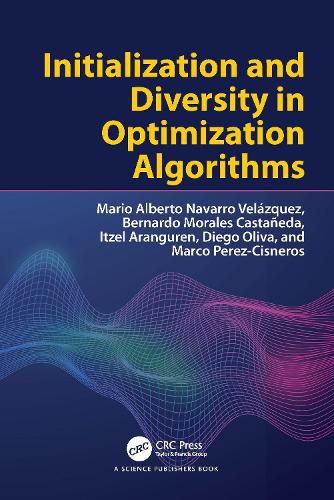
Designing new algorithms in swarm intelligence is a complex undertaking. Two critical factors have been seen to have a direct correlation with positive results. First is initialization, which serves as the initial step for all swarm intelligence techniques. Candidate solutions are generated to form the initial population, which are subsequently modified during the iterative process. A well-initialized population increases the algorithm's chances of avoiding local optima and finding the global optimum in fewer iterations. Although random distributions are commonly used for initialization, there are various ways to initialize the population elements.
Maintaining diversity among the population elements throughout the iterative process is also essential. This diversity facilitates a more thorough and efficient exploration of the search space. In swarm intelligence algorithms, there are multiple methods to measure diversity, each with its own advantages and disadvantages.
This book presents the theory behind the initialization process and the different mechanisms. Additionally, it includes a comparative study of various diversity indicators. It explores different methodologies to compute its value and explains how it can be incorporated as a mechanism for deciding when to apply operators during the optimization process. Multiple examples are provided in the book using two classical algorithms: Differential Evolution and Particle Swarm Optimization. It includes MATLAB (R) code and offers several exercises that readers can use for experimentation and design purposes.
$9.00 standard shipping within Australia
FREE standard shipping within Australia for orders over $100.00
Express & International shipping calculated at checkout
Stock availability can be subject to change without notice. We recommend calling the shop or contacting our online team to check availability of low stock items. Please see our Shopping Online page for more details.
Designing new algorithms in swarm intelligence is a complex undertaking. Two critical factors have been seen to have a direct correlation with positive results. First is initialization, which serves as the initial step for all swarm intelligence techniques. Candidate solutions are generated to form the initial population, which are subsequently modified during the iterative process. A well-initialized population increases the algorithm's chances of avoiding local optima and finding the global optimum in fewer iterations. Although random distributions are commonly used for initialization, there are various ways to initialize the population elements.
Maintaining diversity among the population elements throughout the iterative process is also essential. This diversity facilitates a more thorough and efficient exploration of the search space. In swarm intelligence algorithms, there are multiple methods to measure diversity, each with its own advantages and disadvantages.
This book presents the theory behind the initialization process and the different mechanisms. Additionally, it includes a comparative study of various diversity indicators. It explores different methodologies to compute its value and explains how it can be incorporated as a mechanism for deciding when to apply operators during the optimization process. Multiple examples are provided in the book using two classical algorithms: Differential Evolution and Particle Swarm Optimization. It includes MATLAB (R) code and offers several exercises that readers can use for experimentation and design purposes.
Search our extensive online catalogue.
